
I’ve often noted that even the very first Gospel we know of (the one eventually source-credited to someone named Mark), despite often being described as the least fantastical or the most mundane narrative of Jesus, is in fact wildly fantastical, and does not even come close to resembling the actual histories and biographies of the era that are actually mundane and mostly lack the fantastical. I discuss this generically with comparative examples in chapter 7 of Not the Impossible Faith and specifically with examples from Mark in chapters 3 and 6 of Jesus from Outer Space (and various other places). But today I want to make a complete list. In a book or journal article it would be too long for space. But no such limit need contain me here.
Analytical Context
It should first be noted that in antiquity there was no clear demarcation between the natural and the supernatural. The subject was debated, but without modern science and global experience, the ability to draw any lines was quite limited—and almost wholly rejected by believers in the supernatural, who accepted wild tales as being just as plausibly historical as mundane ones (see Establishing the Biblical Literalism of Early Christians and Christianity Is a Conspiracy Theory), indeed precisely because they believed the operation of the divine and the magical in the world was routine—even “natural.” Moreover, even now, with our demarcations available (see Naturalism Is Not an Axiom of the Sciences but a Conclusion of Them and The Argument from Specified Complexity against Supernaturalism, as well as, for example, The Rain Miracle of Marcus Aurelius: A Case Study in Christian Lies and Theism & Atheism: Miracles), we can also tell the difference between the plausible and the fantastical even within the domain of what is now known to be naturally possible (see, for example, Formalized Gullibility as a Modern Christian Methodology).
In other words, the real issue is not cataloguing every “supernatural” event in the narrative Mark—which would be anachronistic because our modern categorization of what counts as “supernatural” did not exist then, and still wouldn’t capture the whole of the fantastical and thus obviously mythical. Indeed, many of the events in Mark that we would readily recognize as fiction because of their utter lack of realism are technically still “possible,” insofar as it would violate no laws of physics, but they are still wildly unlikely—hence they remain extraordinary claims (which thus require extraordinary, and not mundane, evidence). For example, you can give a naturalistic explanation of the Ten Plagues of Egypt, but the probability that what you just described ever happened is astronomically small—to the point of being de facto impossible. We might call this “statistically impossible,” like the sequence of events in almost any big-budget action movie or screwball comedy or plot-twisting thriller. (On the kinds of impossibility, see discussion in my study for Biology & Philosophy, where the “statistically impossible” is used by creationists to “disprove” natural biogenesis, so we know they well understand this kind of impossibility when it suits them.)
However, I won’t be counting here mere errors or anachronisms. For example, the way the Gospel of Mark portrays the Pharisees makes no sense in actual context; and the extant text of Mark screws up local geography. I will only reckon up here the genuinely fantastical—things that simply wouldn’t likely happen in a universal sense, such as defy (even if they don’t strictly violate) physics or human psychology. I have long noted that by this standard, there is at least one impossible event narrated in every single chapter of Mark. In fact, the count is well more than one. Mark is therefore wildly more mythological in composition than any genuine history or biography of the time. And Mark resembles only ancient fiction and mythology in this respect. And yet Mark is the first narrative of a historical Jesus, and the core (and only really known) source for every other. Such wild fiction was rarely composed about historical persons; but not usually.
Okay. Here we go…
Chapter 1
In Mark 1:
- Jesus is the prophesied chosen one of a Levantine starlord (1:1–3).
- The sky tears open and a magical bird flies down to live inside Jesus’s body (1:10).
- God’s voice booms from the sky declaring Jesus his beloved son (1:11).
- The magical bird inside Jesus tells him to go on a shamanic quest (1:12).
- Jesus hangs out with wild animals and an immortal darklord called “The Satan” for over a month (1:13).
- During which space creatures known as “The Messengers” fly down to attend to Jesus’s needs (1:13).
- Jesus walks up to some total strangers and asks them to leave their families and jobs and depart and serve him—and they immediately do, without any convincing, or even description of what they will be preaching or why they should believe in him or his message (1:16–18).
- In fact, they literally just drop their nets in the sea and abandon their boats and equipment (1:18).
- Jesus does this a second time! (1:19) Although this time, the abandoners of their families leave their equipment with their dad and some henchmen (1:20). The first ones didn’t even do that.
- Jesus extraordinarily amazes everyone at a synagogue with his teaching, exceeding (we’re told) even the greatest scholars of the age (1:21–22)—yet we aren’t told anything of what he taught or how it was extraordinary or what anyone thought was special about it.
- Before many witnesses, an alien being speaks to Jesus, using a human body it lives inside and controls (1:23–24), proclaiming him a magical exorcist empowered by God.
- Jesus magically expels that alien with a word of command (1:25–26), and it then screams loudly after it has left the body it was controlling—thus no longer using a human body as its mouthpiece, the alien entity speaks with its own supernatural voice.
- Witnesses marvel at all this single incident, and Jesus somehow becomes famous for just this one event across the entire region of Galilee (1:27–28), even though Jewish exorcisms were common side-shows of the day.
- Jesus magically cures a woman of influenza (1:29–31).
- Jesus magically cures many of various nonspecific ailments and possession by alien beings (1:32–34).
- We learn that Jesus can telepathically control the voices of the many alien beings he orders out of human bodies (1:34), although he evidently forgot to control that first one.
- Jesus keeps magically defeating alien beings (1:39).
- With a mere touch Jesus instantly cures a man of a mytho-biblical skin disease (1:40–42). Jesus is also inexplicably annoyed by this one diseased penitent.
- Jesus inexplicably strongly insists (ἐμβριμησάμενος) that this one (and only this one) patient of his not tell anyone about it, but that he perform an ancient magical ritual for it (1:43–44); and instead, the guy inexplicably blabs about it to everyone (1:45).
- Jesus thus becomes so famous and successful a wizard that he can’t even enter a town anymore and has to hide from people in the wilderness, yet inexplicably even that doesn’t work and he is continuously mobbed by people anyway (1:45).
That’s at least 20 fantastical things in chapter 1 alone. Out of 45 verses, that’s a rate of almost one fantastical thing every 2 verses. It is the most fantastical chapter in Mark.
Chapter 2
In Mark 2:
- Jesus is so mobbed in one town that some guys have to climb up and tear open the roof of where Jesus is speaking and lower in a victim of paralysis whom Jesus magically cures with a mere command (2:1–5, 11–12), which we’re told no one had ever seen before, despite psychosomatic healing acts being then commonplace. (It also never occurs to anyone to just let the guy in or have him carried in by the audience. And it never occurs to Jesus to go out to him, or tell his audience to let him in. And no one is concerned about the damage to the roof. There are just a lot of weird things to explain away here.)
- Jesus magically reads the minds of the town elite (2:6–10).
- Jesus casts the instant “summon person” spell again, and a guy abandons his job at once, mid-shift, and for no described reason (2:13–24).
That’s 3 fantastical things in chapter 2. Out of 28 verses, that’s a rate of almost one fantastical thing every 9 verses. Our total rate is now 23/73 or almost 1 fantastical thing every 3 verses.
Most of this chapter is also occupied with fables (chreiae) that are obviously intended to teach principles of the Christian mission, like evangelizing sinners, and Christian doctrines about fasting and the Sabbath, using plausible-sounding narratives. So, although these are not fantastical, they are still clearly mythical.
Chapter 3
In Mark 3:
- Jesus magically unshrivels a hand with a word of command (3:1–5).
- The narrator magically knows that this is when the elite began to strategize “how to kill” Jesus, and for the strange reason that he commanded a healing on the Sabbath (Mark will soon forget this motive and impute another later on), yet they inexplicably don’t simply arrest and try him for the crime if it was one (it wasn’t), nor can they even think of a reason to kill him (the verse says they conferred on how they might kill him; not that he should be killed for this, or any particular thing at all). (The Herodians are also now mentioned as plotters, but they have never been introduced as a character before now, and despite the narrator’s magical knowledge, their motive is never explained. And we will never hear of their involvement in this conspiracy again.)
- Jesus magically defeats more space aliens (3:11–12).
- Jesus bestows this power on twelve disciples (3:13–15).
That’s 4 fantastical things in chapter 3. Out of 35 verses, that’s almost a rate of one fantastical thing every 11 verses. Our total rate is now 26/108 or 1 fantastical thing every 4 verses.
Most of this chapter is also occupied, again, by doctrinally relevant fables that aren’t implausible per se but are nevertheless probably false. For example, the entire story of Jesus denouncing his family serves the function of explaining the Christian principle of fictive kinship (and the need to leave family for the Christian community). The story is thus obviously an etiological myth, just like the baptism scene (which sets Jesus up as the successor and superior to the famous preacher John, a competitor to the Christian mission, and explains the doctrinal function of Christian baptism as adoption by God and infusion of the Holy Spirit).
Chapter 4
In Mark 4:
- Jesus teaches everyone only (4:34) in riddles that no one understands, not even his disciples (so how was his teaching so impressive as to draw crowds from over a hundred miles around?), and even more implausibly, Jesus secretly explains his very intention is not to be understood (4:10–12, 33–34).
- Jesus practices weather magic before a dozen witnesses (4:36–42).
That’s 2 fantastical things in chapter 4. Out of 41 verses, that’s almost a rate of one fantastical thing every 10 verses. Our total rate is now 30/149 or 1 fantastical thing every 5 verses.
Most of this chapter is a repetition of a collection of parables and explaining the mechanism of parable secrecy, and trivial activities that barely seem narratively relevant, when in actual fact, those features have literary functions just like all the previous fables do, and are therefore also mythical (see my analysis of the Gospel of Mark’s literary structure in Chapter 10.4 of On the Historicity of Jesus).
Chapter 5
In Mark 5:
- Jesus meets a ghoul with supernatural strength because he was possessed by aliens (5:1–5).
- The ghoul magically knows Jesus is a celestial emissary and tries to make him get rid of the aliens (5:6).
- Jesus has a conversation with a literal alien army inside the ghoul (5:7–10).
- For some unexplained reason, the aliens controlling the ghoul don’t want to be tormented by Jesus (5:6), yet let the ghoul they are inhabiting run up to Jesus even though he was far away (5:6), and just as inexplicably, when they beg Jesus not to make them leave the country (χώρας), Jesus is okay with that idea, and lets them instead magically murder two thousand pigs (5:11–13). It is not explained where they then went, or why they would have wanted to live inside two thousand pigs, or why they wanted to immediately kill the bodies they were just allowed to inhabit—or why Jesus would want any of this.
- Though the town’s local economy is thus completely devastated by the most extraordinary property crime in history, Jesus does nothing about it (5:14–16), and inexplicably, the townsfolk only insist Jesus merely leave; they attempt no legal action nor ask for him to pay for their massive loss (5:17).
- Jesus resurrects the dead with a word of command (5:21–24, 35–42).
- Jesus’s robe is so magical it cures at a mere touch a bizarre gynecological disorder (5:25–34).
- Jesus can feel his magical power drained by this touch to his cloak (5:30).
- Even though Jesus resurrected a girl at a request made in front of crowds (5:21–24), after she had been publicly declared and mourned as dead (5:35–40), Jesus inexplicably asks that it be kept secret (5:43), which to any realistic observer would be obviously impossible. (Also, apparently, resurrected people need food to eat. You’d think a resurrection spell from a god would at least supply you with adequate blood sugar. Mark must be playing by 5e rules.)
That’s 9 fantastical things in chapter 5. Out of 43 verses, that’s almost a rate of one fantastical thing every 8 verses. Our total rate is now 39/192 or 1 fantastical thing every 5 verses.
Chapter 6
In Mark 6:
- Inexplicably, despite marvelous wizardry famed across seven lands, Jesus cannot perform any exorcisms, and hardly any healing spells, in his own town (whose inhabitants are apparently Nega-Psychics: 6:1–6).
- Jesus gives his twelve disciples magical powers again (6:7, 13), though unlike Jesus, their power to heal requires spell ingredients.
- We are told a wildly implausible story about how Herod unwillingly executes John the Baptist by accident (6:14–29; in historical fact, he had far more plausible motives). This is actually full of fantastical elements, yet that only work collectively together, so I’ll just count it all as one.
- In no universe would any king make the promise the plot requires (6:22–23), much less honor it (6:26), even less for the reasons given (a king would readily bat aside the impolitic wishes of a mere girl in front of elite guests—honoring it would make him appear weak, not refusing it).
- The time compression of the story is laughable. Herod Antipas’s Galilean palace was over a hundred miles from John the Baptist’s prison, a week round trip by fast horse. And even if his birthday banquet was for some reason held outside his kingdom in Jerusalem, the distance is still over sixty miles, four days around by fast horse. And either way John the Baptist’s head would have rotted for days by the time it was delivered on a platter.
- The tale has John’s disciples travel to the prison to collect and bury John’s body after they learn of the delivery of his head (6:29). In fact Jewish law mandated burial before sunset. That means John would have been buried in the prison graveyard days or even weeks before his disciples even learned of his death, much less could arrive to take the body for a burial already completed.
- Thousands of people implausibly horde into the desert to see Jesus but, despite being experienced rural travelers, don’t think to bring any provisions (6:30–36). Worse, they apparently need to be told to go get some (real people don’t need reminding).
- Twelve jobless rural disciples inexplicably have hundreds of silver coins on hand and are merely concerned about draining their purse (6:37). In a more realistic story, it would be “Where the hell are we going to get that kind of cash?” Or “Shall we take donations and send runners?” Or “Shall we marshal foraging and hunting teams and gear up to do some fishing?” Anything but “Hey, man, I know our pony is fat with staxx, but come on, bro!”
- Although Jesus asks his disciples to feed these thousands of people, inexplicably, Jesus does (6:38–44). So why didn’t he just say, “I’ll take care of it”? (Note that in all cases like this, I often do know the literary reason that Mark wrote it the way he does; I am just cataloguing when the result is historically unrealistic. So, for example, here the story is a fable teaching readers a cryptic lesson about the Christian mission. But as such, it is completely ahistorical, and thus fantastical.)
- For some inexplicable reason, all that twelve rural travelers can pull together is two fish (two? bad day at the nets?) and five loaves of bread (6:38). Why did they think to bring only five? And are we to believe that literally five thousand other people are on hand, and not a single soul has even a morsel to contribute to this pop-up soup kitchen? And why is it just fish and bread? No vegetables, fruits, grains, nuts, berries, beans, cheese, preserves, honey, beer, wine, posca, bugs, sausage, or any other meats, fresh or jerked? Not even some fowl or varmint? No shepherds in these thousands with some goat, lamb, or beef?
- Jesus magically feeds five thousand people by a conjuration of self-replicating food (6:41–44).
- And there are inexplicably “twelve basketfuls of broken pieces of bread and fish” left over after five thousand people ate (6:43). Um. There would be vastly more poop left over than that (a problem with which the narrator is blissfully unconcerned). (And where did these twelve baskets come from? Were they just hauling around empty baskets this whole time? And isn’t twelve a cheekily suspicious number?)
- Jesus magically walks on water before a dozen witnesses (6:45–53).
- Jesus performs more weather magic (6:51).
- Jesus’s magical cloak heals the ailments of every single person who touches it (6:54–56).
That’s 12 fantastical things in chapter 6. Out of 56 verses, that’s almost a rate of one fantastical thing every 4 verses. Our total rate is now 51/248 or 1 fantastical thing every 5 verses.
This chapter is mostly a list of etiological myths teaching doctrinal lessons (such as why Christians don’t live kosher, 7:15) that are plausible per se but not likely historical (e.g. a departure from kosher practice was invented after Jesus died).
Chapter 7
In Mark 7:
- Despite having spent dozens of hours with Jesus—hours of public instruction, hours of private instruction—spanning many days of opportunity to ask him questions and have whole lengthy conversations about his answers and his mission and his teachings and ideas, the disciples still don’t understand even basic things he says (7:17–23).
- While trying to hide from crowds (a contradictory objective for a divine being whose only mission at the time is mass public communications), Jesus is inexplicably found out by a woman with a kid inhabited by an alien being, and after a testy racist argument she finally gets Jesus to begrudgingly do something about it (7:24–29).
- As usual, Jesus magically removes the alien, but this time he can do it at long range and without even line-of-sight, evincing Jesus has leveled up the spell (7:30).
- Jesus magically heals a deaf man with reiki, saliva exchange, and a word of command (7:32–35).
- Despite that spell being cast in public at public request, Jesus implausibly “commands” (διεστείλατο) that no one tell anyone about it; and, of course, everyone tells everyone about it—in fact, the more he insists they don’t, the more they do it (7:36–37).
That’s 5 fantastical things in chapter 7. Out of 37 verses, that’s almost a rate of one fantastical thing every 7 verses. Our total rate is now 56/285 or 1 fantastical thing every 5 verses.
Chapter 8
In Mark 8:
- Another implausible scenario of four thousand travelers forgetting or neglecting provisions (8:1–3).
- The disciples (and even Jesus himself) inexplicably have their memory deleted of the last time this happened (8:4–5). Indeed it is inexplicable why even Jesus wouldn’t remember this problem and have planned for or avoided it by now. It’s especially weird that everyone implausibly forgets not only that Jesus is a wizard with a conjure food spell, but, again, that food can be procured by foraging, hunting, fishing, and pooling resources among the thousands attending.
- Inexplicably, again, twelve practiced travelers, and thousands of experienced rural peasants, have only seven loaves of bread and “a few” fish, and nothing else (8:5–7).
- Jesus magically feeds four thousand people by a conjuration of self-replicating food (8:8–9).
- Inexplicably, again, after four thousand meals, only seven baskets of crumbs are left over (8:8–9).
- Inexplicably, immediately after that, the disciples literally “forget” to bring any food with them, but for a single loaf of bread (8:14–16).
- When Jesus utters another cryptic remark, the disciples inexplicably forget that Jesus does that a lot, and instead think he is referring to the loaf of bread (8:17–18).
- Jesus explains the matter to them by completely failing to explain anything to them; yet not a one of them asks a follow-up question to clarify whatever his point was supposed to be (8:19–21).
- Jesus magically cures a blind man with an elaborate travel-and-spit ritual (8:22–25).
- Jesus’s spell fails. He has to cast it again, wasting another spell slot (8:23–25).
- Jesus inexplicably insists the cured man go home and not back to the village where the villagers had brought the blind man to Jesus (8:26). Inexplicably, Jesus does not command him to tell no one; and the reason for going straight home eludes any explanation. (The villagers are going to notice eventually that he isn’t blind anymore, after bringing him to Jesus for a cure, and watching Jesus lead him away; it’s also not explained why none of the villagers followed Jesus and the man, since everyone else has been following Jesus even into foodless wastelands by the thousands and Jesus could never find privacy up to now.)
- Inexplicably, Jesus warns the disciples not to tell anyone about him (8:30)—a guy who has been preaching the gospel to audiences of thousands by now and is already famed across seven lands, and was already publicly declared the chosen one by a booming voice from heaven (1:11).
- In a wildly implausible scene, Jesus “openly” explains to the disciples how prophecy predicts his death and resurrection, and Peter inexplicably “rebukes” him for it (ἐπιτιμᾶν), at which Jesus inexplicably accuses him of being a worldly servant of Satan (8:31–33), rather than simply correcting whatever mistake Peter made and explaining why this is a good thing and how they can help bring it about. Indeed there is actually nothing at all humanly plausible about the conversation here depicted.
That’s 13 fantastical things in chapter 8. Out of 38 verses, that’s almost a rate of one fantastical thing every 3 verses. Our total rate is now 69/323 or 1 fantastical thing almost every 5 verses.
The rest of this chapter (continuing into 9:1) has Jesus elaborate his bizarre conspiracy theory about cosmology and the fate of the world, which isn’t fantastical because weirdos with weird beliefs are commonplace. But this will be relevant later when, despite such a clear exposition of things (with again, obviously, in reality hours of questions and discussion ensuing), the disciples will continue never to have understood any of it.
Chapter 9
In Mark 9:
- Jesus becomes Gandalf the White (9:2–3).
- Inexplicably, ancient dead men descend from outer space (9:4–6). (I am setting aside the question of how anyone knows what Elijah and Moses “look like,” because maybe Jesus introduced them?)
- A magical talking cloud joins the show and proclaims Jesus the One (9:7).
- Inexplicably, the extraterrestrial revenants then instantly vanish (9:8).
- Twelve Jews having heard Jesus preach and converse about resurrection for days on end don’t know what “resurrection” is (9:9–10).
- Twelve Jews forget that they themselves have recited at every Passover of their lives why people say Elijah shall precede the Messiah (9:11–13).
- Jesus tells them Elijah has already come and been persecuted—and no one asks a follow-up question as to who he means or how he knows they’re actually Elijah (9:13). (And didn’t they just meet Elijah at the top of this episode?)
- An alien possesses another child, and no one’s magic can expel it (9:14–18).
- Jesus inexplicably curses out the crowd, who literally have nothing to do with this (9:19).
- Jesus is the only wizard with a spell slot of sufficient level to expel the alien (9:20–27).
- The disciples ask Jesus why their spell didn’t work, and Jesus inexplicably replies that “This kind can come out only by prayer” (9:28–29) even though that isn’t true—Jesus expelled it without any prayer. (Some manuscripts even add “and fasting,” which obviously also didn’t happen. Jesus also never explains why “this” alien is any different than the others, or why “only prayer” can expel it, or what prayer, or how that would be any different from just casting another spell.)
- The disciples still can’t understand what Jesus means by his being prophesied to die and rise, despite his very clear exposition of that already, and their having had hours of access to question him about it for days now (9:30–32).
- Other wizards expel aliens (9:38–40).
That’s 13 fantastical things in chapter 9. Out of 50 verses, that’s almost a rate of one fantastical thing every 3 verses. Our total rate is now 82/373 or 1 fantastical thing almost every 5 verses.
Chapter 10
In Mark 10:
- Inexplicably, the people tell a blind man asking Jesus for help to shut up—the opposite of every similar scene to date (10:46–48).
- Jesus instantly cures this one—without ritual, spell ingredients, or failure this time (10:48–52).
- This man, Bartimaeus we are told, then follows Jesus—but we never hear of him again (10:52).
That’s 3 fantastical things in chapter 10. Out of 52 verses, that’s almost a rate of one fantastical thing every 17 verses. Our total rate is now 85/425 or 1 fantastical thing every 5 verses.
This chapter is mostly filled with parables and fables, as before, which teach doctrine or concepts and thus are no more likely to be historical, but are not fantastical.
Chapter 11
In Mark 11:
- A fantastical donkey heist (11:1–6).
- A wildly implausible triumphal entry scene, conveniently corresponding to various details of prophecy, that none of the ruling authorities or city guard notice or ever remark upon (11:7–11).
- Jesus magically withers a fig tree (11:12–15, 19–25).
- Implausibly, Jesus even does this in anger at it not feeding him when he was hungry (10:12) even though he knew it wasn’t fig season (11:13) and thus not its fault.
- Implausibly, “Jesus entered the temple courts and began driving out those who were buying and selling there, overturning the tables of the money changers and the benches of those selling doves, and not allowing anyone to carry merchandise through the temple courts” (11:15–18). But: “The temple square was a heavily populated space over ten acres in size and guarded by an armed battalion authorized to kill troublemakers on sight” (JFOS, p. 54; see OHJ, pp. 431–42).
- Completely unbelievably, Jesus shuts up all of Jerusalem’s Elders, Priests, and Rabbis with his (not at all) brilliant refusal to answer them when they ask on what authority he did any of that (11:27–33), and in result, no one arrests him for the outrageous (and probably capital) crime he just publicly committed (the violent defiling of the temple grounds and operations). (The Gospel Jesus was actually quite bad at argument. But many people were. What makes this fantastical is that the scene is completely unrealistic and can never have happened as described.)
That’s 6 fantastical things in chapter 11. Out of 33 verses, that’s almost a rate of one fantastical thing every 5 verses. Our total rate is now 91/458 or 1 fantastical thing every 5 verses.
Chapter 12
In Mark 12:
- Fantastically, “the chief priests, the teachers of the law and the elders” of Jerusalem, the very capital of Judea, “looked for a way to arrest” Jesus “because they knew he had spoken [a] parable against them” (12:12). In no way would the entirety of a city elite conspire to assassinate someone simply “because he spoke a parable against them” (having inexplicably forgotten their original motive, in episode three). And in no way would they need to conspire to “find a way” to kill him: in-story, they could already get him for indisputable felonies and public acts of treason.
- Fantastically, after having criminally and violently assaulted the temple and its occupants, Jesus just casually goes on “teaching in the temple courts” unimpeded (12:35).
That’s 2 fantastical things in chapter 12. Out of 44 verses, that’s almost a rate of one fantastical thing every 22 verses. Our total rate is now 93/502 or 1 fantastical thing every 5 verses.
This chapter mostly consists of teachings couched in trivial narrative contexts, or scenes meant to teach lessons (like the fable of the widow’s mite), and thus still mythical, but set in mundane scenes. There are anachronisms. For example, Jesus is depicted pithily answering a question about paying the Romans taxes (12:15–17), but the scene depends on those taxes being paid with the Roman denarius (which has the emperor’s visage upon it). In Judea, that was not the case. Taxes there were paid with special faceless coins minted for compliance with the Jewish law against icons. But as I said at the outset, anachronisms (mere historical errors) also abound in Mark, but I am only counting fantastical things—things that couldn’t happen in any genuine historical context, such as defiances of ordinary human psychology.
Chapter 13
Mark 13 entirely consists of a single speech by Jesus in an obvious set-scene (a classic staged soliloquy). The speech consists of ridiculous and ahistorical apocalyptic teachings, but such beliefs were common and thus, though still obviously mythical here, nevertheless not fantastical. So with no opportunity to throw in ridiculous events, we get 0 out of 37, getting us to 93/539, which is still almost 1 fantastical thing every 6 verses.
Chapter 14
In Mark 14:
- “The chief priests and the teachers of the law” are still (!?) “scheming to arrest Jesus secretly and kill him” but, they concluded, “not during the festival, or the people may riot” (14:1–2). Yet, fantastically (and completely unintelligibly) they do that anyway, in the most public and flagrant way possible—by actually arresting him and publicly executing him in the middle of the festival! And no one riots.
- An impossible story about a peasant’s eighteen-thousand dollar alabaster nard jar being pointlessly smashed over Jesus’s head instead of funding poverty programs (14:3–9).
- An unidentified woman does this for no logical or historically intelligible reason.
- Jesus says she will be memorialized forever (Mk 14:9), yet Mark doesn’t even name her. And we never learn anything about her and never hear of her again (she vanishes from history).
- No one would anoint Jesus for burial (Mk 14:8) days before his death.
- Nor would any commoner be carrying around an $18,000 pot of oil (see OHJ, 452n131).
- Nor would they smash it over someone’s head: because the woman does not just pour the oil out, but even breaks its delicate stone container, a wholly pointless and wasteful thing to do (Mk 14:3).
- It is not even plausible that any oil could carry such value, much less commonplace spikenard (unless the quantity exceeded all logical purpose, and everyone in the room was gassed into unconsciousness by the intense aroma); and although the valuation may be for the container being carved from alabaster—a cheap stone, but perhaps the craftwork was priceworthy?—smashing the container is then the crime against the poor, not pouring out the oil, which makes even less sense, since…
- Jesus’ excuse for thus destroying almost twenty thousand dollars is fantastical and can never have happened (such a cost was not needed for his burial; he wasn’t even dead yet; and this doesn’t explain destroying its expensive container, or why nard oil specifically was necessary, or why it even needed to be in such a container).
- Fantastically, Judas suddenly decides on his own to conspire to get Jesus killed, and for no intelligible reason given in the story (14:10-11).
- A strange tale of a boy and his water and a miraculous hotel comp (14:12–16).
- A completely implausible story of Jesus psychically knowing about Judas’s secret conspiracy (14:17–20); and announcing it to everyone, yet keeping his identity secret for no historically plausible reason; and no one presses Jesus for who it is or how he knows this or why he won’t take action—or why he even mentioned it if he wasn’t going to do anything about it. We don’t even get a believable conversation about Jesus needing the conspiracy to go forward to effect his plans, as he has suggested before—although there is also no discernible reason why he would need it, either, since, as we’ll see, Judas performs no relevant function. Jesus also threatens the conspirator with a horrific punishment, but if Jesus needed him to do it, it is unclear why he should be punished for it; or why Jesus should want to threaten him, as if to deter him from doing what Jesus actually wanted to encourage him to do. In short, the entire scene makes no sense and cannot have happened.
- Fantastically, Jesus describes a detailed psychic premonition that comes true in every particular (14:27–31, 66–72). And despite Peter being warned, and knowing Jesus is a genuine wizard and a real psychic, he still goes through with it. It’s also not explained why Peter is hanging around the courthouse (14:54) to be recognized by one of the court staff after having fled arrest. That’s a strange thing for a fugitive to do. Why hasn’t he already booked it over the border to hide in non-Roman Galilee (per 14:28 and 16:7)?
- All twelve disciples are implausibly (even comically) sleepy (14:32–42). (Jesus must have cast 5e Sleep by accident.)
- A completely implausible arrest scene (14:43–52).
- Judas leads an armed police squad to effect the arrest (43). But why was Judas needed? Jesus could have been arrested by such an armed force anytime. (We were even told the plan was to do this after the festival and all its pilgrims had left.) And anyone could have tailed him to Gethsemane. How would Judas know any better that that’s where he’d be? We can make up retcons here. But none of this makes any sense as written.
- Judas inexplicably arranges a secret signal to point Jesus out (44–46)—but he’s already there with a visibly armed police squad, so why did he need a secret signal? He would just say, “That’s him!”
- There is no intelligible reason Judas is needed to point out a man so famous he had been seen and even conversed with by thousands of persons, including much of Jerusalem’s elite, which would have had many of their staff in attendance as well.
- All of this is so obviously unintelligible that Mark has Jesus “fourth wall” a supernatural explanation of why all this is happening so oddly (48–49).
- The police then seize only Jesus (46)—so why did everyone else run away? (50) Remember, Judas was supposed to be secretly signaling who to arrest—which makes no sense if they came there to arrest everyone and sort out who’s who later.
- Maybe it was because someone (oddly, we are not told who, or why, or why only them) attack the police with a sword and viciously mutilate “the high priest’s servant” (47). But…the police did nothing about this. They don’t even defend the servant, strike back, or pursue the armed felon. Which makes no sense. (It’s also not explained why the high priest’s servant is even there. Not even the high priest is there: in v. 43 Mark says the police were sent “from” the high priests [παρὰ] not “with” them.)
- “A young man, wearing nothing but a linen garment, was following Jesus; and when they seized him, he fled naked, leaving his garment behind” (14:51–52). That’s all we hear about this bizarre event, or the boy. This is so weird and out-of-the-blue it deserves to be counted separately.
- No one can come up with a crime to convict Jesus of (14:55–56).
- Days of plotting and the entire elite of Jerusalem can’t even feed their stool pigeons a convincing lie to convict Jesus with (14:57–61). Herod just had the widely beloved John executed “because, bint.” And these guys can’t even frame Jesus?
- They eventually convict Jesus of something that isn’t even a crime, much less a capital one, under either Jewish or Roman law (14:61–64). But if they could do that all along, why did they need the stool pigeons? And why did Mark say they couldn’t come up with a crime to pin on him? The entire scene makes no sense as written.
That’s 12 fantastical things in chapter 14. Out of 72 verses, that’s almost a rate of one fantastical thing every 6 verses. And that’s not even counting ahistorical anachronisms (such as that this fails to correspond to anything we know about how Jewish trials worked—at all, least of all capital ones). In any case, our total rate is now 105/611 or 1 fantastical thing every 6 verses.
Chapter 15
In Mark 15:
- A wildly implausible fable about a Roman “prisoner release” ritual that coincidentally evokes an entire Jewish Levitical atonement ritual (15:6–8).
- Unintelligibly, the crowds so behind Jesus that the elite feared their rioting at his mere arrest immediately switch allegiance to the elite and loudly call for Jesus to be killed (15:8–14).
- Fantastically, Pilate releases a murderous rebel against Rome and executes Jesus at the whim of a mob no Roman magistrate would heed (15:15).
- Fantastically, a random stranger we are told little about and never hear of again is forced to carry the cross for Jesus for no explicated reason (15:21).
- The entire scene duplicates too many odd features from Psalm 22 to plausibly be historical (OHJ, 408).
- The sun is blotted out from the Earth for three hours even at full moon (15:33–34).
- Implausibly, Jesus dies almost immediately and without explanation (15:34–37). Crucifixion was intended to keep the victim alive (and suffering) for days. Even Pilate is surprised he died so quickly (15:44).
- The magical bird that entered to live inside Jesus’s body at his baptism now leaves him (15:37: ἐξέπνευσεν, ek + pneuma, “the spirit went out,” vs. 1:10, pneuma + eis, “the spirit went in”).
- A massively public, 80-foot tall tapestry, on which was depicted the heavens (Josephus, Jewish War 5.212–14) magically tears from top to bottom as Jesus dies. (Thus coincidentally the heavens tear apart both at Jesus’s magical birth—his baptism, 1:10—and magical death.)
That’s 9 fantastical things in chapter 15. Out of 47 verses, that’s almost a rate of one fantastical thing every 5 verses. Our total rate is now 114/658 or almost 1 fantastical thing every 6 verses.
Chapter 16
In Mark 16:
- A magical escape (16:2–4).
- A magical boy (16:5–7).
- Inexplicably silent witnesses (16:8).
If we keep going and include the later addition of a longer ending:
- A magical appearance of the dead (16:9)
- More alien inhabitants of human bodies (16:9).
- A transmuted revenant encounter (16:12).
- A magical ghost shows up for dinner (16:14–18).
- Jesus flies into outer space (16:19).
- The disciples become wizards (16:17–18, 20).
That’s either 3 or 9 fantastical things in chapter 16. Out of either 8 or 20 verses (respectively), that’s almost a rate of one fantastical thing every 2 verses. Our total rate is now either 117/666 or 123/678, leaving us with an average of almost 1 fantastical thing every 6 verses across the entire Gospel of Mark, or an average rate of 7 fantastical things per chapter—and over a hundred fantastical things altogether.
How gullible do we have to be?
Discover more from Richard Carrier Blogs
Subscribe to get the latest posts sent to your email.






Amazing analysis of the magic in Mark!
If there was a plot-accurate movie, (with birds and aliens flying in and out of bodies, Judas inserted with no plot function to the Jesus story itself), how would reviewers, Catholics and Evangelicals respond?
Or is faith in Jesus so resistant to disclosure of its actual written basis, that such a film would have no effect on our culture?
I have always wanted to do a literalist movie (not just of the NT but even the OT…bears mauling forty lads anyone? — with corpse mutilations and mass murder-rape campaigns, the OT is more fycked up than Game of Thrones; while the NT is more like a David Lynch movie).
A literal filming of Mark would come across as very weird. Yet that a 100% spot on accurate depiction is so weird would be a message unto itself. It would be hard to do it with a straight face.
the two silly events with loaves and fishes always amuse me. This means that poor ol’ JC was wandering around roman-occupied Judea being followed by a literal roman legion’s worth of men, and no one noticed.
That also brings up a good point.
I mention this general point in my other work, it just didn’t count as an individual fantasticality for this analysis, but: the Gospels massively exaggerate the fame of Jesus (in Matthew he becomes famed across all of Syria even), with massively public events that could never have escaped the notice of historians like Josephus. It’s not just having thousands of peasants massing continuously in the wilderness (which means entire towns and jobs were being depopulated in the interim, which means production and commerce was being interrupted across the entire region), but all the incredibly huge public events Jesus causes (from the triumphal entry and temple raid to murdering thousands of pigs and blotting out the sun; I mention a few others above), any one of which (much less so many conjoined) would get notice in history books.
The mainstream response is to admit that, therefore, these things cannot have happened, that this is legendary embellishment, and that Jesus was actually much less famous than this and did things far more mundane and trivial. Which solves the Argument from Silence. But at the cost of losing traction on one’s ability to explain why he gained such a following at all, or so moved them to declare him a demigod and form an entire religion around him. It’s not impossible to thread this needle, but that a needle has to be threaded here means hypotheses of a historical Jesus have to be functionally elaborate and filled with ad hoc assumptions.
This is a great summary. How the literalism of “gospel truth” became victorious for so long is a testament to the power of political oppression under Christendom. My view is the intent of the Gospel of Mark was to imagine what a Messiah would have done if he had actually existed, with readers understanding that this alternative history was imaginary, like the novel Fatherland by Robert Harris. The suppression of this original fictional intent was central to efforts to make the Nicene Creed the basis of imperial security and stability by rejecting all religious debate. Even the evidence that there was a debate had to be suppressed.
At some point I wonder if there was also an intent to provide some entertainment value to these stories to keep the reader or listener engaged.
Oh, yes. Certainly. Indeed, that is why they are stories in the first place. As opposed to just an analytical theological treatise or even a sober methodological history. This was actually centrally taught in schools of the time as an effective technique of communication and persuasion. The power of stories to teach and change minds was recognized as a tactic since before even Aristotle.
You have to imagine how frustrating it’d be to hang out with any of the Synoptic Jesuses. “Like, this guy seems like a cool hippie liberal but he’s doing all this weird shit. He’s deliberately antagonizing my rabbis even when he could probably just be cool. He teaches in all these parables and no one gets it, and he’s obviously smart enough to know that. And he keeps doing all this Messiah shit but he keeps being cagey about it even though it’s going to get him killed. He keeps telling us to be secret about this shit he is doing super overtly. Pick a lane!”
(Though the fact that the disciples have all that money would be an indication that either they and/or Jesus are actually running the standard traveling con. I loved the interpretation of Judas that he got pissed when Jesus was spending money on himself and Mary Magdalene and finally believed his rabbi was a power-tripping cult leader).
To be fair to the rabbis, assuming that poor people will riot and then having them not do that is a classic example of elite panic.
Also, holy shit, fantastic Nega-Psychic reference. Top tier nerd snipe. Incidentally, it’s clear that they included the Nega-Psychics in Beyond the Supernatural to allow people to play skeptics in a universe where that would be increasingly impossible. In Rifts, denying magic and the supernatural would obviously be absolute nonsense, so there the Nega-Psychics know full well the supernatural is real, and they believe they can kick its ass.
I was wondering if you’d seen Chrissy and the French (Canadian?) on myth vision or read their paper. I feel like they inadvertently did a lot of your work for you in fully sharpening the comparison between Jesus and Romulus! Romulus was the only other character on their list who was mythical right away, not just “over time.” They’re not paying attention closely enough to realize that, forget “Mark,” not even Paul was writing about Jesus like a historian would’ve written about a historical figure! You were right! The real “historical Jesus Christs” are simply the “historical Joshua Messiahs” from Josephus! They were all the “historical Jesus” we ever needed! Such a shame that people can’t get over their expectations!
It’s almost insulting that a lot of people still think the stories come from “oral traditions” about a historical figure rather than traditions from reading the scriptures like a Bible code! They’re not thinking schizotypally! They don’t realize that you have to decode the meanings of the gospel stories from the Bible code readings of the “scriptures”! I remember crying listening to the last few chapters of OHJ (I was high), just because of how stupid it would be to interpret the stories you were writing about as historical rather than symbolic! Their taking (stealing, so to speak) the “James the just” story and identifying him with James the pillar (and then identifying him with Jesus’s biological brother) really got to me. If that makes sense 😛
There are more technical issues with their argument. But I will get to that finally this month.
There are actually two different versions of Mark. The original version begins with the baptism and ends with the tomb (there is no resurection). The second version has additional lines added to Mark 16. This is referred to as the “Mark 16” problem by some academics ( https://en.wikipedia.org/wiki/Mark_16 )
Um. I actually already mention that. That’s why I give two final counts. Please look at my section on Chapter 16 above.
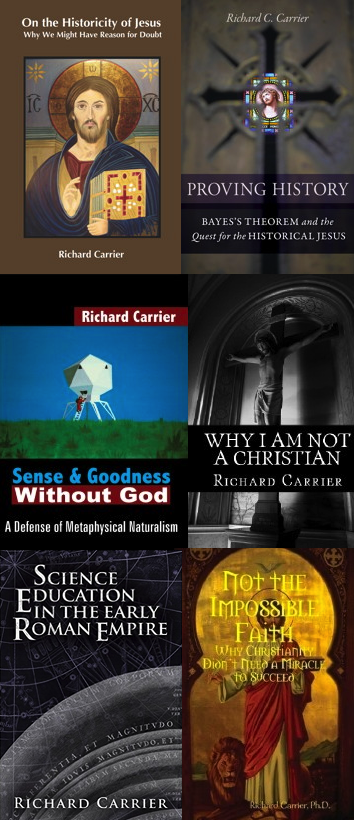
But if you are really interested in this, you should know there are actually, in fact, five different versions of Mark, including one that has Jesus fly into outer space with an army of angels, and another in which he gives a short soliloquy about Satan. I thoroughly document and discuss them and all the pertinent scholarship in a chapter in Hitler Homer Bible Christ.
I have to push back on the idea that a person being famous for saying things beyond understanding is implausible. Deepak Chopra, Donald Trump, and many others fit this category.
(Of course, Jesus warns of the fall of Jerusalem just as Jeremiah warned of the fall of Jerusalem, and it was important in both cases that the people did not actually understand. God warned them, so He is off the hook. Its not great logic, but it seems to be consistently used.)
I explicitly agree. That’s why I said that I don’t count those things.
I outright said more than once that people saying crazy things is not fantastical (hence I score nothing in Mark 13, because it is just a speech that “consists of ridiculous and ahistorical apocalyptic teachings, but such beliefs were common and thus, though still obviously mythical here, nevertheless not fantastical”).
None of my scored items consists of someone merely saying or believing something crazy. They all consist of things that are simply extremely improbable physically or psychologically. For example, even Donald Trump and Deepak Chopra have never and will never walk up to someone who knows nothing about them and in two sentences convince them to abandon their property, jobs, and families to follow them on a religious mission. Even crazy people need more backgrounding and convincing than that. Hence, that is fantastical.
As for “being famous,” Jesus does not become famous for saying fantastical things. I only scored “Jesus somehow becomes famous for just this one event across the entire region of Galilee (1:27–28), even though Jewish exorcisms were common side-shows of the day” (no analogy here to Trump or Chopra, neither of whom became instantly famous for a single act that was commonly performed in their culture by hundreds of other people—much less without the existence of telemedia).
What are your thoughts about Mark’s work and its author’s literary skills, apart from the apologetic side? Reading this entry and chapter 10.4 in OHJ the guy looks like a genius for me, if he really meant all these allegories, chiastic-triadic-reversal structures and all. I know – you mention that these skills were even taught in schools, but considering how MASSIVELY influential the Gospel of Mark become, I wonder to what extent was it a stand-out work, and how is it possible that we know nothing about the author, given that all the other writers were using Mark as a source.
On the other hand, it seems like at the time all these allegories and borrowings should be pretty easy to catch by the public? We may struggle with it 2000 years later, but wouldn’t the Moses analogies, for example, be obvious for contemporary Jews?
Mark is definitely an artist, very well educated, and a master of the craft. Especially for choosing to compose in a popular idiom (like Mark Twain did).
Normally, an author would boast of this (and thus their name would be all over it), but that isn’t always the case (the lives of Aesop are unnamed; as are many other ancient masterworks, so not everyone was inclined to market themselves over their art).
I believe Mark is sincere (he is not just pulling a FAFO, as Walsh might be taken to suggest, but really believes what he is selling), which means he takes seriously its entire central message (of humility, the least shall be first, etc., modeled by the woman forever remembered but never named, which may even be a version of the author’s signature—which does not mean the author was a woman, but that they symbolized themself with one, another act of humility).
As to how much of his ingenuity would be “visible” to the masses: contrary to many scholars, I think very little. It was the elite who were trained to appreciate this; and only exceptional members of the illiterate public could spot it on their own (this is why all religions trend toward literalism instead of allegorism).
Mark’s additional layer of genius is composing a tale that hits both markets well. His text can be sold as literal to an incomprehending public and still convey its core messages; while Mark would expect elite movement leaders to teach from the text and thus illumine the public that way, as Mark even illustrates by example.
Which would have a psychological effect (triggering an affective fallacy): as these clever devices are made clear to the public, they would feel the exhilaration of discovery and genius, mistake it for the holy spirit, and be more inclined to believe God is behind this movement.
I think the God’s Not Dead movie is a good analog for the Gospel of Mark. It’s a story of Josh Wheaton, a college student who defends his faith in a philosophy class against the atheist Professor Radisson. It was popular amongst the Christian community when it came out and was even shown in Christian churches across the world. The issue with this is that Josh Wheaton and Professor Radisson don’t exist. The footage shown in these churches is a literary creation of Pure Flix Entertainment. Josh and his professor are actors. The events portrayed in the film never happened. Yet if you were to ask these Christians that played the film in their churches if the movie God’s Not Dead is “true”, they would say “Of course it is!”. To them, the point of the film is to convey modern Christian persecution in the form of a narrative, not as a historical record of the college experiences of Josh Wheaton. Wheaton is just a character used in a story they want to tell. If we want to judge Mark on the merits of his story we first have to understand what his intent is. It’s a difficult thing to do because we don’t know who he was, when he wrote, or who he wrote to.
I was listening to HwaP by Tool recently! Maynard does something very similar in that song to a magician revealing his tricks! He’s peeling back the layers of his own mythology! You’re reading Mark like Maynard would! Imagine being a fan of Jesus, and then “meeting” him in your hallucinations only for him to tell you, “all you know about me’s what I’ve sold you, dumb f*ck!” 🤣🤣🤣
This was hilarious. Would you consider doing the same article but for Acts?
If I understand Bayes Theory correctly, each fantastical event raises the “impossibility level.” This should put the issue to bed: Mark is fiction.
Your general conclusion is correct; and indeed the fantastical events are not the only evidence Mark is fiction. There are converging lines of evidence (I mentioned anachronisms already, but there are other signals, including format, mimesis, and discourse style, which I discuss in OHJ, Ch. 10.4).
There are diminishing returns, though. Once the hypothesis of fiction is already confirmed to a high probability, adding more fiction to it has less and less significance. For example, in terms of likelihood multipliers, 99.99% is ten times more than 99.9%, but in practice we do not regard this difference to significant. The argument was already over when you hit 99.
I discuss this some in OHJ: The Covington Review (Part 3)
Dear Richard, while I have no argument with your overall thesis, that is that the gospel of Mark and the other gospels are essentially fabulous, that is made up stories, I’m more interested in what the point of the stories were. My take is that Mark is essentially a teaching tool, that as I think you said at some point it is one big parable. Taking it as such, do you discuss anywhere what the parable is designed to teach? Or can you point me to someone who does (without getting bogged down in the facticity or otherwise of the story)? I was intrigued by your reference to the fact that although Mark is written in a naïf kitchen Greek style, the author was trained in compositional theory.
I agree. I think studying what they mean (why they were written) rather than their “faciticity” should be biblical studies’ primary function.
Hence I devote a lot of work on that elsewhere.
See Ch. 10 of On the Historicity of Jesus and the second half of my “Spiritual Body” chapter (“The Legend of the Empty Tomb”) in The Empty Tomb, and various articles here (as just top examples: Like, Can You Rebel Against Rome with Only Two Swords?, Mark’s Use of Paul’s Epistles, Why Did Mark Invent an Empty Tomb?, and A Thorough Fisk of the Arguments of Fernando Bermejo-Rubio and Franco Tommasi).
I also cite and vouch for Crossan’s study on the very hypothesis you endorse, The Power of Parable. And I discuss the importance of the teaching-tool model in Historicity and Proving History, Ch. 5).
Hello Dr. Carrier. Not sure if we ask questions here but if we do I have one.
I was curious if you think Mark may have moved the disciples good post-easter stories back in time (transfiguration, Peter’s confession, Jesus commissioning the Twelve) IN ORDER to discredit them later on by ending their stories in disgrace (Judas Betrayal, Peter’s Denial, Desertion by the rest) as Mark is seemingly anti-disciple and pro-Paul therefore taking away any post-easter prestige.
This may be why Mark moved Jesus becoming Messiah back to him baptism instead of ressurection since he didn’t want readers to think they renewed their faith in understanding Jesus as Messiah. So he moved Jesus messiahship back to discredit them in a post-easter world.
Whether you agree or not I was also curious if you knew any scholars or authors who argue specifically this point. While I disagree with you on Jesus mythicism I do appreciate your skepticism of the gospel narratives.
All the best, William.
I haven’t seen that specifically, but it’s a plausible hypothesis generally. Notice how John does the opposite: moving Luke’s ministry fishing scene into a post-resurrection scene. James Tabor and others have suggested the original of that was in a lost ending to Mark, and it was Luke who moved the scene back into the ministry. So you are in that same trend of thinking at least.
I am not convinced by it. But I could be if evidence were found for it. So I think it’s worth exploring, if any enterprising graduate students wants to tackle it. I’m just not optimistic enough to devote any energy myself.
Mark actually redeems the apostles (having the Boy/Angel announce he will appear to them in Galilee, which Matthew then narrates). So he isn’t really that hard bent on hiding their reports. So that part of the thesis is contradicted by the evidence.
And when Matthew reinvents a report, he keeps the mountain part (emulating Moses, a common theme in Matthew, who invented the Sermon on the Mount), but nothing else from the Transfiguration (and leaves that where Mark put it). And so on. So if Mark did what you propose, no one else knew he did. Which would require positing Mark had exceptional knowledge of apostolic stories everyone else didn’t.
I was looking for study notes for Mark for my Bible study group. I am an agnostic / atheist / syncretist who recently was converted to Christ by the Holy Spirit. I understand how difficult it is to believe, because mostly, without the help of the guiding Holy Spirit your eyes will not see and your ears will not hear. I totally understand.
However, if you soften your heart, open your mind the the possibility, read the King James version of the Bible, and repent, you may be able to then pray and beg the Holy Spirit to enter you and do His work. I know this sounds fantastical, but it seems to be the way it works for most people.
It’s easy to pick the holes, but if you look around there is just too much evidence for God, Jesus Christ, and the Bible. Take this example, if Jesus Christ wasn’t the Son of God, our Lord and Saviour, nobody would bother to attack Him, as He said people would, for the last 2,000 years, just as you do.
I really enjoyed your notes and they really helped me deepen my learning of Mark. I have read the story many times, and will start again tonight after reading your work. Your count for count post of the elements of the story highlight just how amazing the story is.
Did you know that the extra verses that some Bibles add to the end start after verse 666 (total verses).
Look up KJVCode. And – The Astonishing Pattern of SEVENS in Genesis 1:1 by Ivan Panin:“In the beginning God created the heavens and the earth”
Beloved Numerologist | Koinonia House
Your reasoning is illogical.
By dismissing all contrary evidence by claiming a Cartesian Demon (the Devil or something?) is hiding the evidence from everyone else, you are trapping yourself in a control belief (see my Primer on Media Literacy).
Functionally, that’s a circular argument from which you cannot escape. Which would sustain any false belief in any false religion (a Muslim can say exactly the same thing, as can a Buddhist: see The Outsider Test for Faith). Which is why religious epistemology is always bad for you.
In truth, the evidence shows your Holy Spirit methodology is wholly unreliable, as it usually leads people to false beliefs, and thus is maximally truth-avoiding, not truth-finding. See my analytical summary of the Argument from Religious Experience (and its followup in Ten Ways the World Would Be Different If God Existed).
As proof of concept, I went through exactly the same thing as you: a Holy Spirit encounter convinced me Taoism was true and that people didn’t realize it because they did not let the Tao in to teach them (I summarize my story early on in Sense and Goodness without God). It’s an identical methodology. Yet leads to false conclusions. Your brain is prone to self-convincing like this, including through altered states of consciousness.
You will never realize this as long as you stick to the control-belief that it is impossible and thus all this evidence is to be disregarded.
Thank you for taking the time to reply.
You describe my reasoning as “illogical” because you believe appealing to divine action creates an unfalsifiable belief. Yet much of your own worldview rests on assumptions that cannot be demonstrated by empirical means either. You trust in a materialist framework in which consciousness, rationality, moral intuition, and subjective experience all arise from non-rational physical processes. But this leads to a well-known philosophical difficulty: if all our beliefs are produced solely by blind physical causation, then our confidence in the reliability of human reasoning is weakened at the root. This concern has been raised by thinkers across the philosophical spectrum, including those with no commitment to Christianity.
You argue that religious epistemology is “truth-avoiding”, but the reliability of reason itself is not something science can prove; it is a precondition for science. Materialism begins with philosophical commitments every bit as non-empirical as those you criticise in faith. The question is not whether one side has assumptions, but whether those assumptions adequately account for the totality of human experience—reason, consciousness, morality, meaning, and the fine-tuned intelligibility of the universe.
Your recommendation of the “Outsider Test for Faith” can be applied equally to materialism. An outsider could ask:
These are not scientific questions; they are metaphysical ones. And naturalism answers them no more decisively than Christianity.
Regarding religious experience: you argue that because such experiences vary across traditions, they are therefore unreliable. But this commits the fallacy of overreach. That some interpretations are mistaken does not mean all are. Much of what we rely on in daily life—our sense of moral truth, the reality of other minds, our trust in our own rational faculties—is not verifiable by laboratory experiment, yet we treat these experiences as meaningful and often self-authenticating.
Your own former experience, which you interpreted through Taoism, is not evidence that all spiritual experiences are misguided—only that you later judged yours to have been. That does not settle the matter for anyone else, nor does it tell us whether any particular tradition has stronger evidential foundations. Christianity rests not solely on experience, but on historical claims, philosophical coherence, and a cumulative case that includes but is not limited to the transformative experiences of believers.
My point is simply this: scientific reasoning itself rests on philosophical premises, and those premises are just as open to scrutiny as any theological claim. A worldview is not made rational merely by excluding God, nor irrational merely by including Him. To dismiss a category of evidence because it does not fit within materialism is not critical thinking—it is a limitation imposed by one’s starting assumptions.
Even Jesus addressed this issue. He recognised that the challenge is not the absence of evidence but the posture with which evidence is approached:
“Seeing they see not; and hearing they hear not, neither do they understand.
Matthew 13:13
And He did not ask for blind belief. Instead, He offered a testable principle of discernment grounded in lived alignment with truth:
“If any man will do His will, he shall know of the doctrine, whether it be of God.
John 7:17
These statements cut directly against the claim that Christian faith is a closed loop. They assert that understanding is possible—but only when approached with intellectual humility and a willingness to consider realities beyond the material.
Before closing, may I ask a sincere question: have you ever read the entire Bible, cover to cover? It is difficult to dismiss a worldview comprehensively without having examined its primary text in full.
And a final thought: you are betting your entire existence on the assumption that we are nothing more than accidental carbon-based life forms clinging to a rock flying through space, that consciousness ends at death, and that there is no transcendent reality beyond this brief life (or any other world view). If that bet is wrong, the consequences may be far greater than any of us can currently imagine. It is worth asking – philosophically, not emotionally – whether that is truly the most rational horse to back.
Everything is illogical unless it follows without fallacy from true premises.
So, your reliance on the identified fallacies is illogical.
By contrast, my worldview is not based on assumptions but vast accumulated evidence. That’s how I left Taoism for Naturalism: I started paying attention to the evidence, and reasoning without fallacy from it (I started being logical).
Thus, you falsely believe we simply “assume” the things you list. Thus your belief is based on a false belief. In fact everything we believe is entirely based on evidence and inescapable reason.
I summarize all this in Sense and Goodness without God (so it sounds like you need to read that), but I have added to it since:
The evidence for mind-brain physicalism is vast and convincing to anyone thinking logically (see my “mind” tag in the category dropdown menu, which is down the right margin here on a desktop browser).
The evidence for the absence of supernaturalism (everything is physical without remainder) is vast and convincing to anyone thinking logically (start at Naturalism Is Not an Axiom of the Sciences but a Conclusion of Them).
And that purposeful explanations are inherently more complex and thus require more evidence than unpurposeful ones is a logically necessary fact (start at The Argument from Specified Complexity against Supernaturalism and then Defining Naturalism: The Definitive Account and The Cartesian Demon Problem).
And the evidence for the absence of cosmic purposes as a cause is vast and convincing to anyone thinking logically (see Ten Ways the World Would Be Different If God Existed and my “atheism” tag).
And that’s just the reality. You are evading this reality with nonlogical reasoning and a commitment to false premises (like that all the evidence I just referred you to doesn’t exist and we are just “assuming” our positions on things).
And until you confront that fact about yourself, you will never escape the hall of mirrors you have trapped yourself in.
The world, universe, biology, physics, are vastly illogical. It’s only our brain desperately trying to make sense of it that allows us to get through the day without tipping into madness. Our conscious mind creates the narrative that we are making decisions and are in control of our lives – Gilchrist – and we are plugged into the quantum field – Penrose.
Explain molecular machines that are for more advanced than our own technology and far more than a machine which is an insult and deceit to refer to them as so.
https://youtu.be/7Hk9jct2ozY?si=cRDR2a557JeG0gZp
Logic. Wisdom is the fear of God.
Forgive me for not reading your book, and I mean that sincerely, however, after reading my whole life and finally only reading the Bible in the last year or so, it is now the only book I plan to read again and again for the near future. It stands by far as a book of all books and I am only left wondering why I never thought to read it before, but then we know we have satan to credit for that deception.
Thanks for your replies.
There is nothing “illogical” about “the world, universe, biology, physics.” That you think this is another one of those delusions I just warned you were trapped in. You don’t know what you are taking about and don’t want to know what you are talking about. Hall of mirrors. You are trapped.
That you don’t know cells are thousands of times more evolved than even humans, and thus you mistake billions of years of evolution as “advanced technology” (no different than ancient aliens thinking), is another example of this (see discussion, discussion, discussion).
You don’t know what you are talking about because you refuse to learn how any of this happened or really works. You are a Christian because you are willfully ignorant, avoiding every effort to learn the science, with every excuse. I am not a Christian because I insist on being informed before deciding what’s true.
And that’s the difference between us.
I would also say that the Abrahamic religions which account for the vast majority of the world, and you can include any other religion if you like are stacked against you, as logical evidence. And include eminent scientists and a vast majority of Nobel winners being Jewish. You are a tiny minority in a bubble pushed on us in the West by a group of people The Changing Image of Manz Stanford Research Institute. You are their target audience. Those people and their work is well documented in the Bible.
You just proved my point.
“It’s popular, therefore it’s true” is exactly one of those fallacies I was talking about.
You should be a Muslim (2 billion) or a Hindu (1.2 billion) by that account. Christians are the minority (2.3 billion). With 1 billion Buddhists and pagans, and 1.9 billion nonreligious, that’s 2 + 1.2 + 1 + 1.9 = 6.1 billion non-Christians. They outnumber Christians by 3:1. That’s not “the vast majority,” it’s a minority. You know why this argument is fallacious as soon as the numbers go against you. But you didn’t think of this when you tried to use it as if it were convincing. That’s the hall of mirrors you’re in.
Meanwhile, I have no idea what a “Manz Stanford Research Institute” is or what it has to do with anything here.
I would suggest that the balance of history, culture, and intellectual tradition does not favour your position as strongly as you imply. The Abrahamic religions alone account for the majority of humanity across time, geography, and civilisation. This is not a proof of truth, but it is relevant evidence against the claim that belief in God is merely a psychological defect or a failure of reason. Large-scale, persistent convergence across cultures requires explanation, not dismissal.
This is especially so when one considers the disproportionate representation of Jewish thinkers among major scientific advances and Nobel laureates. A worldview grounded in creation, intelligibility, order, and rational law has historically fuelled scientific inquiry rather than obstructed it.
I am not separating Christianity from other religious traditions at this point, but situating it within the much broader and historically dominant human conviction that reality is grounded in God or gods. Across civilisations and millennia, the overwhelming majority of human beings have concluded that the universe is not self-existent or purely accidental, but contingent upon a transcendent source. That near-universal intuition does not by itself identify which tradition is correct, but it does strongly suggest that theism is the default human conclusion, not an irrational anomaly.
You suggest that Christianity survives by ignorance of science. My own experience is the opposite. I became a Christian precisely because I followed physics, biology, and evolution to their limits. What I found there was not a triumphant materialist conclusion, but an abyss of unresolved foundations.
At that point, resistance to theism is often no longer evidential but existential. A universe with no ultimate ground requires no ultimate accountability. If reality is finally impersonal, then no one stands in judgement over our actions, motives, or inner lives. That is not a scientific conclusion; it is a moral relief. And it helps explain why alternatives that remove transcendence are so readily embraced even when their explanatory power runs out.
We are repeatedly told that science has explained reality. Yet at its deepest levels, it has explained descriptions, not essences.
We can model behaviour, measure effects, and predict outcomes, but this is not the same as ontological explanation. When we move beyond atoms, electrons, and quarks, we arrive not at solid objects but at probability fields and mathematical abstractions. At the foundation of matter itself, there is not “stuff” but potential.
Even space, long assumed to be empty, is now understood to be saturated with energy. And when we look outward, cosmology does not reveal a universe expanding into something, but into nothing at all. That is not a solution; it is a metaphysical wall.
Biology mirrors this pattern. The closer we look at even a single cell, the further understanding retreats. Molecular systems display layers of interdependence, coordination, and informational precision that dwarf human engineering. Calling these “machines” already strains language; pretending they are the inevitable result of blind, unguided processes stretches credulity even further.
You dismiss irreducible complexity, yet the problem is not rhetorical it is explanatory. Describing a process is not the same as accounting for its origin. Saying “evolution did it” without explaining how information, organisation, and function arise is not science; it is narrative.
Nor does naturalism fare better with meaning or morality. If we are merely accidental arrangements of matter, produced by forces indifferent to truth or goodness, then compassion, reason, and moral obligation are evolutionary illusions useful fictions at best. Yet no one actually lives that way. You would not believe you could crush another person’s skull “without judgement” simply because they are a collection of atoms. You know this intuitively, because moral reality presses itself upon us whether we want it to or not.
Appeals to neurons and chemistry do not solve this. Neuroplasticity, preserved personality after catastrophic brain damage, and the persistence of consciousness despite massive physical loss all undermine the simplistic claim that mind is merely what the brain does. Correlation is not identity.
You accuse me of retreating into superstition. I would suggest instead that modern materialism retreats into overconfidence claiming certainty where none exists, and mistaking methodological success for metaphysical completeness.
I am not a Christian because I am afraid of science. I am a Christian because I followed science as far as it would go and found that it does not, and cannot, close the circle.
At that boundary, one must choose: either reality is ultimately irrational, purposeless, and groundless, or it is grounded in mind, meaning, and intention.
I chose the latter, not because it is comfortable, but because it is coherent.
And finally, I would note that the modern psychological and cultural project which treats religious belief as a defect is itself neither neutral nor accidental. The work The Changing Image of Man produced by the Stanford Research Institute explicitly examined how human self-understanding could be reshaped away from transcendence. That trajectory is well documented and anticipated long before by Scripture itself.
You see mirrors. I see unanswered foundations.
The difference between us is not that one of us values reason and the other does not. It is that we disagree about where reason ultimately points.
This is all false, James.
You need to actually study these things to understand them—rather than use your not understanding them as an excuse to remain trapped in your delusions.
But I cannot help you with that. It’s something you have to realize on your own. Explaining away the mirrors will forever prevent you seeing them.
“All false” is not an argument; it is a dismissal.
The statements I made are not claims of ignorance, but acknowledgements of recognised limits within physics, biology, and philosophy of science. These limits are openly discussed by leading researchers in their own fields. A moment’s research does not resolve them, because they are not gaps waiting to be filled by one more paper or experiment, they are foundational questions.
In an infinite or effectively unbounded universe, it is reasonable to accept that human knowledge will always be radically incomplete. To insist otherwise is not confidence in science; it is hubris dressed as certainty.
Recognising limits is not delusion. It is intellectual humility.
What we differ on is not whether science is valuable—I agree that it is—but whether it is metaphysically complete. I see no evidence that it is, and considerable evidence that it is not.
If acknowledging that unsettles your worldview, that does not make it false.
Declaring something “all false” without specifying which claims are false, or why, is not scholarship, it is assertion. If the positions I raised are genuinely mistaken, they should be easy to identify and refute directly. Replacing argument with diagnosis does not advance understanding.
James, you literally don’t know what you are talking about.
And here you are, making excuses for not finding out.
Anyone not trapped in a hall of mirrors would peg that as the biggest red flag on the planet.
But you are actually convincing yourself with it.
That should scare you. That it doesn’t is why you are trapped.
You don’t have an arguement, because you cannot find a fault in my my premise. If you can prove me wrong on even one statement, then I will concede:
James, we know all those things. Some to a considerable certainty, and the rest to a sufficient certainty (which means, more certainty than any religion can honestly claim).
All these facts are discussed on my website, with citations to the science and evidence. See the category dropdown menu or use the search box at top right to begin your journey.
Saying that gravity is “the warping of spacetime” tells us how gravity behaves, not what spacetime is, why it exists, or why it has the properties it does. The question is not whether the model works, but what the model is of. Spacetime curvature is a mathematical description, not an explanation of being.
If I measure a table’s dimensions, weight, and material composition, I can describe it with great precision. But none of that tells me who made the table, how it was made, or for what purpose. Measurement yields description; it does not yield origin, agency, or intention. Confusing the two is a category error. Scientific models tell us how reality behaves, not why it exists or what, if anything, it is for.
To state, “Life begins by organic molecules chaining into an autocatalytic set.” is frankly laughable.
For which we have plausible theories, supported by more evidence than any religious alternative. All you have to do is learn about this.
Instead you sit in ignorance thinking things have to have a purpose to exist (ample evidence shows that’s not true), that there are no peer-reviewed scientific theories resting on good arguments and evidence for how and why different things came to be, and what actually they are made of, and why no “person” is needed for any of the stuff we didn’t make ourselves.
Above you made an argument that was fallacious and false, and I proceeded to prove that.
Now you don’t even make an argument. You just laugh at things in total ignorance of what they mean and why they are true.
This is the story of you. Your methodology is emotional, irrational, and broken.
And that is why you believe all these false things.
Only when you realize this can you escape.
You say we have “plausible theories”, or you could just as easily say guesses, and I have learned about them. What I see is that these assumptions when taken to thier logical conclusion are built on a foundation of sand.
You claim there is ample evidence. Yes, there is ample evidence that the Sun is in the sky. And? That is not the question. The question is whether explanatory depth has reached bedrock. I see no evidence that it has. Every layer appears to rest upon prior assumptions..
You say life begins when organic molecules chain into an autocatalytic set. You may as well say a car is made by assembling the parts. The real question is how those parts arise, coordinate, encode information, and cross the threshold into self-sustaining, information-bearing life. That step remains unresolved, doesn’t it. and I think it is disingenuous to state otherwise.
So let me ask you directly: has abiogenesis been demonstrated in full explanatory detail? Yes or no.
You accuse me of ignorance, but I am asking for specificity. If I am wrong, show me precisely where. If abiogenesis has been fully demonstrated, cite the experiment that recreates the complete transition from non-living chemistry to fully functional, self-replicating life.
You say we “know” these things. I see models, hypotheses, and partial accounts, although impressive, cannot be sold off as final explanations.
If acknowledging limits is delusion, then the word has lost its meaning.
Don’t evade. No more “hall of mirrors” metaphors!
Science is not a system of guesses. We aren’t “guessing” at fundamental theories. They are constrained by evidence, simplicity, and precedent. No foundation of sand. If you want to understand why some theories are plausible and others not, you would have to actually check. You still won’t check. And that’s the story of you. You are uninterested in learning anything. You instead are just trying to defend false statements you made because your ego won’t let you admit you were wrong, and wrong because you didn’t know what you were talking about. You’re scared of losing your identity, and of all the bogeymen that people in your identity-group told you to be scared of. And this drives you to fear knowledge. And to fear being found out as wrong even more.
For example, the Sun is not in the sky. It is millions of miles away from the cap of Earth’s atmosphere. And it doesn’t move around in the sky. We spin around and orbit it. The reason we orbit the sun is that spacetime is warped by the mass of the sun. We’ve confirmed it is warped, and warped exactly as theory predicts, empirically. This is not a “guess.” It is not “speculation.” It is a fact. Likewise the “reason” mass bends spacetime is that energy and spacetime are two manifestations of the same thing, and thus there is an identity relation between the shape of spacetime and the amount of matter-energy present. You can’t have matter-energy without spacetime having a particular shape around it. This is a known fact as well.
And what underlies all that? Many viable theories based on evidence, simplicity, and precedent are being explored. They are founded on solid reasoning and facts. Not sand. You could study them if you actually wanted to learn things, but you clearly don’t. But if you did, you could start your breadcrumb here. The contenders explain many bizarre facts, with very few grounding principles, in precisely the way no god theory ever has. Which is the test of a better theory. That’s how science works. And that’s why it keeps kicking theology’s ass.
Likewise: I say “life begins when organic molecules chain into an autocatalytic set” and like a frog-eating peasant you say something stupidly false (and purely emotional) like “you may as well say a car is made by assembling the parts.” No. These are not at all the same thing. The analogy is wildly false. And we know this for a scientific fact. It is not a guess. It is not on sand.
We have proven that certain small organic molecules chain together naturally (without intelligent guidance), and certain simple assemblies of them self-replicate. And they are vastly simpler than cars. And that’s why they have a chance of accidental assembly at large scales (a scale of billions of planets).
See my category drop down menu on the right margin, look for “biogenesis.” I have many articles under that category that will breadcrumb you to all the knowledge, often based on a peer-reviewed journal study I published in 2004, summarizing the state of things then (and we know a lot more now). And there are many fully-in-detail explanations of biogenesis based on all the different ways it can happen, all the way from PNA (autocatalytic molecules) to self-replicating RNA (simple coding molecules) to DNA (complex coding molecules), and likewise from chemistry sets in the wild, to naturally occurring lipid shells, to controlled cells. And likewise from precellular to single celled organisms, to multicelled organisms, to multicelled organisms with tissue differentiation through methyl-group gene switching, and thence all the way to us. There is a whole rich scientific literature on this.
You would know all this if you cared to. You just don’t care to. And that’s the story of you. That’s why you remain trapped in your delusion. While the rest of us left the cave and found out what the facts of the world really are.
We do not yet know what gravity is at the deepest level, and for all we know our current instruments may still be primitive (caveman) relative to what is required for full understanding.
Your biogenesis claim jumps from ”some ingredients or precursors can form naturally” to “life is nearly solved”.
That does not follow. Partial progress in prebiotic chemistry is not the same as demonstrating an end to end pathway to a self-sustaining, evolving living system.
The problem you have with your materialist model of the world isn’t just science its ethics. And that is why God exists, because without the Lord Jesus Christ we have no morals.
And whether you want to believe it or not, you are a Christian. Your entire mindset is built on Christian value – it is the air that you breathe. And without it there is chaos.
That depends on what you mean by “the deepest level.” But if the goal posts are at “do we have plausible ideas about that,” the answer is still yes. Breadcrumbs at Quantum Gravity and Theory of Everything. They are far more evidence-based, component-simple, and unmysterious than any supernatural theory and make more successful specific predictions.
That depends on what you mean by “solved.” But pick what the goal posts are, and either you will get “yes, that was solved” or “yes, we have plausible ideas about that.” Breadcrumbs at RNA World or PNA World or Wong-Hazen depending on how far back you want to look; or if you want the goal posts at somewhere more specific, then, e.g., Origin of Cells or Origin of Multicellular Life, etc. (see TalkOrigins Archive for a never-ending list; if hackers have downed that, you can check the latest capture).
We have that. We’ve even replicated every step in the lab, from PNA self-replicators to available PNA-RNA transitions and RNA-DNA transitions to the evolution of multicellular organisms from single-cellular organisms.
That’s a different claim. So you are moving the goal posts again. But again, you are wrong. Because you didn’t check.
No, it’s not. That’s just a lie you keep being told, and never think to check. You might want to check.
You say we have “plausible theories.” You could just as easily call them guesses. I have looked at them, and what I see is that when these assumptions are pushed to their logical conclusion they rest on layers of prior assumptions that are themselves unexplained.
You say the question depends on what we mean by “the deepest level.” But that is exactly the problem. We do not actually know what the deepest level is, or even if there is one we can reach. Each layer of explanation simply introduces another layer beneath it.
You claim there is ample evidence. Of course there is evidence for observable phenomena. There is also ample evidence that the Sun appears in the sky every day. But that is not the question. The question is whether explanatory depth has reached bedrock. I see no evidence that it has. Every layer appears to rest upon prior assumptions: mathematical intelligibility, stable law, existence of fields, existence of energy, existence of quantum states. None of those explain why reality exists or why it has the structure it does.
Take something like the Aharonov-Bohm Effect. It demonstrates that electromagnetic potentials can influence particles even in regions where the classical electromagnetic fields are zero. In other words, effects occur where, according to older intuition, “nothing” should be acting at all. That alone should caution anyone against speaking as though physics has reached final explanatory ground. The deeper we probe, the stranger and less intuitive the foundations appear.
On biogenesis you move from “some ingredients can form naturally” to the claim that the problem is essentially solved. That leap is exactly what I object to.
That step remains unresolved. To suggest otherwise is disingenuous.
So I will ask the same question again: has abiogenesis been demonstrated end-to-end in full explanatory detail? Has any experiment recreated the complete transition from non-living chemistry to a fully functional, self-replicating living cell? If the answer is yes, cite the experiment. If the answer is no, then we are still dealing with models and hypotheses, however impressive they may be.
I have a Bible that solves how life began that is just as close to being proven as your solution ever will. The only difference is I know it can never be solved by man, and you can’t accept that.
You say we “know” these things. What I see are partial accounts and research programmes that may eventually lead somewhere, but they cannot honestly be presented as final explanations.
You also dismissed the moral argument by saying it had nothing to do with science. Yet your worldview rests on ethical assumptions as much as scientific ones. If morality is simply a product of rational agents negotiating cooperation, then morality ultimately becomes whatever those agents agree it to be.
History shows exactly what that leads to. Slavery has been accepted by majorities. Child marriage has been accepted by majorities. Genocide has been justified by majorities. In practice, the 51 have often decided the fate of the 49, or more realistically the 1% decide for the rest.
That is precisely why the question of moral grounding matters.
None of this is an attack on science. Science is an extraordinary tool for describing how the physical world behaves. But describing behaviour is not the same thing as explaining why reality exists, why it is intelligible, or why moral obligations bind us.
Acknowledging those limits is not ignorance. It is intellectual humility.
And finally, to prove that you are a person and not AI, what do the red and green tickets say on the header image of this site:
http://www.skegnesspattesting.co.uk/index.php
If you are replying personally, that should be a very simple question to answer.
Incorrect. A guess is just a guess. Whereas a plausible theory is a theory that (1) actually works as an explanation (2) includes no kinds of components not already known from evidence to exist and (3) matches all current observations, especially the most peculiar. The most plausible theory is the one that then (4) has the fewest unconfirmed components. Theism, by contrast, has never gotten past (1) and rarely even gets that.
Past experience tells us that theories meeting (1)-(4) turn out to be true most of the time; and the rest of the time they turn out to be at least somewhere close to being true. So we know the method works. That’s why science makes so much progress so fast, and theology and other pseudosciences make none.
False. There are theories in actual science that meet (1)-(4) in answering this. I linked you to summaries.
Indeed. Search “what causes the Aharonov-Bohm Effect” and you’ll find numerous helpful guides.
“the classical electromagnetic fields” => classical; we are a quantum world. Classical effects only exist at classical scales. Below classical scales everything is quantum. One of the most fundamental features of “quantum” mechanics (it’s even in the name) is that there are no fractional energies. Therefore there can never be a zero energy. This is QM 101.
And if you ask “why” that is, the answer is the virtual particle sea. Search that phrase to understand what that is. Then search “zero point energy” for the effects it causes. This also causes the “unattainability principle” of the Third Law of Thermodynamics.
At a deeper level of analysis all of these things are the inevitable consequence of any large randomized system of discreet units, which statistically can never reach absolute zero in any relevant property (see, again, All the Laws of Thermodynamics Are Inevitable).
That you didn’t know we already explained the Aharonov-Bohm Effect is exactly what is causing you to remain trapped in your delusion. You don’t even think to check whether we had explained it and what the explanation was! Even after I warned you to do this multiple times now. Still you won’t check so as to even know what you are talking about. Take a close and serious look inside yourself to answer why you keep doing this.
There is no leap. The gap is crossed by (1)-(4). And sometimes even: (5) actual confirmation and thus certainty. Ask any question you want about biogenesis, and we have an answer fulfilling (1)-(4) or (5). Theism can’t even fill (1). See Oh No! Biogenesis Is Impossible?? A Case Study in Creationist Lies.
Yes. See previous link and the links direct to the science I already gave you. We have (1)-(4) on every single step. And (5) on many. Theism can’t get us even (1) on any.
Yes. Artificial self-replicators (a.k.a. life) have been routinely created in the lab. If you read any of the links I told you to, you should already know this (the smallest is the Lee peptide although the Schreiber peptide will surpass it; the largest is the saRNA family). We’ve now even carried this all the way to creating our own cells.
For either to happen naturally requires vastly more time than we have in labs—but that’s a prediction, and it has been confirmed: natural origins of life took billions of cosmic years and evolution of the cell millions and its diversification into being able to form multi-tissue animals and plants took billions more. Exactly as predicted. In fact, all expected evolutionary timelines (the time it takes for mutation-reproduction to transform one known genome into another, e.g. from bacterium to whale) are empirically confirmed.
This is a confirmation of theory.
Theism can’t accomplish any of this. It explains none of it. And appeals to powers and entities and motivations that there is no evidence of. It fails to meet (1), (2), (3), (4), or (5). It’s therefore a terrible theory. Whereas existing biogenesis models meet all four or even five. That’s the definition of a good theory. And it’s called an explanation. We have more evidence for that explanation than any theist one. So theism cannot claim to have explained what we have explained without it. Unless you can get God to replicate his process and demonstrate his intentions in a lab (to borrow your own absurd standards).
We have what you don’t.
And that’s why science works and theism doesn’t.
I did not say that. I said it’s a different science than you had been asking about. So it was changing the subject to avoid having been beaten on the subjects you originally chose to lose on.
It is clear you didn’t check the link I gave you that explains science has also answered morality (with (1) to (4) for most things and even (5) on the rest). Morality is its own science. And scientific knowledge of it exists, and more is obtainable.
Not in China.
Medieval and modern slavery comes from your Bible. Not from common human sentiment. And certainly not from any empirical inquiry into the best way to live.
Actually it predominates from Biblical Jews and Christians and those they influenced (Muslims are just another sect of Jewish Christianity). Your Bible even legalizes the sex slavery of girls, by literal command of your God.
Just as we used to be barbarians and savages with barbaric and savage morals (like those in your Bible), the Enlightenment has led us to truer and wiser and better morals. That is when age of consent to marry rose (indeed even consent to marry, which your Bible outlaws, compelling marriage without consent even to a woman’s rapist). The Bible had no such effect. So if you think a higher age of consent signals a reliable access to moral truth, you are obligated by your own standards to abandon your Bible as barbaric and evil, and adopt rational, evidence-based morality instead. Like the rest of us.
False. It’s really only Biblical. The Bible invented the idea of genocide as a divine policy. And all genocides in history were inspired by its model.
Most cultures by far (in the ethnographic record, at least 99%) never engage in genocide. And 100% of cultures not influenced by the Bible.
Unless you include “mere” forced relocation (which establishes modern Israel as genocidal beyond question) rather than mass murder (which also establishes modern Israel as genocidal), but even then, we’re back to 99% of cultures never did that either.
So it appears your Bible is the villain here. Not common human sentiment. Most savages balk at the idea. While your Bible made it law.
P.S. “what do the red and green tickets say on the header image of this site,” Skegness PAT testing & 1st Aid Courses, but that is literally the page meta-title, so any AI could have answered that. You can’t test an AI the way you think (especially as we had reliable OCR decades before today’s pseudo-AI). You need to use more discerning skills.
The red and green tickets do not say that.
Oh, you mean the tickets themselves, not the red and green <em>text</em>?
The tickets have dozens of words on them. So I have no idea which words you want repeated at you.
Pick which text you want.
on the left hand sides of the tickets.
Failed (red) and Passed (Green)
Failed (red) and Passed (Green)
You see how even a simple observation can be misread.
I’ll use your own framework for a moment. You lean on ideas like an infinite or multiverse reality. But if reality is infinite, or constantly generating new layers, then by definition we can never reach a final explanation. Every answer simply pushes the question back one step further.
That isn’t solving the problem, it is deferring it indefinitely.
On abiogenesis, you continue to claim the problem is solved. But the question has been simple and consistent which is, has the full transition from non-living chemistry to a fully self-sustaining, replicating cell been demonstrated end-to-end? Not partial steps, not models, but the complete process.
If the answer is yes, cite it clearly. If not, then we are still dealing with incomplete explanations.
At that point, the disagreement is no longer scientific but philosophical.
And I can’t believe you used China as an example. They didn’t avoid slavery out of moral advancement; Chairman Mao murdered millions instead. Social credit scores? Where is the freedom in that nightmare? Not to mention the Uyghur Muslims. Shame on you.
You have built a hall of mirrors that you call your universe. You have no idea what is outside it, and in each mirror you see answers that you believe to be truths and solutions to something that can never be fully understood. We are but ZX81s trying to surf the internet and understand how it all works.
I thank you for your time and crib sheet of Mark. I will pray for you. I hope God reaches out to you as he did with me. I had what would be considered an amazing life before God, and had reached my bucket list multiple times, however, as I stated the other week when I was baptised, the sins of the flesh compare not one jot with the beauty of living the way God commands us. That is true freedom.
God bless you Richard and anyone who reads these comment. Repent and trust in Jesus Christ.
I have cited numerous studies establishing every thing I said. So for you to keep asking for the citations is looking ridiculous now.
You are at this point just avoiding everything I said and asking for things you don’t need as an excuse to ignore having been refuted.
This is a trend with you.
For example, that you think Mao is relevant to the previous three thousand years of Chinese history—the only thing relevant to a comparison with the Bible (which was not written in the 1940s but thousands of years ago)—tells me you are again avoiding what I actually said, changing the subject to something completely irrelevant, so you can ignore having been refuted again.
You are clearly engaged on nothing but evasion here. You are showing no interest in what I am actually saying or what the truth of it is.
Ask yourself why.
OK, to answer your questions.
“Incorrect. A guess is just a guess. Whereas a plausible theory is a theory that (1) actually works as an explanation (2) includes no kinds of components not already known from evidence to exist and (3) matches all current observations, especially the most peculiar. The most plausible theory is the one that then (4) has the fewest unconfirmed components. Theism, by contrast, has never gotten past (1) and rarely even gets that.”
Is that it? You are basing your salvation and eternity on that?
“what causes the Aharonov-Bohm Effect”
Again, you describe what you can see, but not what (A) is in the equation. I can see God all around me and feel Him within me just the same.
“At a deeper level of analysis all of these things are the inevitable consequence of any large randomised system of discrete units…
“According to the Third Law of Thermodynamics, absolute zero is a limit you can approach but never actually reach, because you’d need an infinite number of steps to remove the final bits of entropy.”
Finite? But we have infinity at our disposal, don;t we? If we live in a finite world, abiogenesis and DNA become next to impossible due to the time and coordination required for unguided processes to generate complex, functional systems.
“There is no leap. The gap is crossed by (1)–(4). And sometimes even: (5) actual confirmation and thus certainty.”
“And sometimes,” you say. It either is or it isn’t. Or are you clutching at DNA chains instead of straws?
“Yes. Artificial self-replicators (a.k.a. life) have been routinely created in the lab.”
Scientists can edit and rewrite the “software” of life (DNA), but they still rely entirely on the “hardware” — the highly complex machinery of an already living cell — to make it function. That is the key point.
From a chemistry perspective — and this is where James Tour is very clear — we are nowhere near demonstrating a realistic pathway from simple molecules to life. In the lab, we can produce individual components, but only under tightly controlled, intelligently guided conditions. That is not the same as showing how life arises naturally.
For example, forming peptide bonds in water is chemically unfavourable, yet water is assumed to be the medium for early life. RNA building blocks degrade under realistic conditions. Sugars like ribose are unstable. Even when components are formed, they interfere with each other, break down, or require conditions that contradict one another.
We are not just missing a step — we are missing the mechanism that explains how chemistry becomes organised, directional, and information-bearing. That is the central problem.
“China and slavery”
Wikipedia: Slavery in China has taken various forms throughout history. Slavery was nominally abolished in 1910, although the practice continued until at least 1949. The Chinese term for slave (奴隶, núlì) can also be roughly translated as “debtor,” “dependent,” or “subject.” Despite attempts to ban it, slavery existed throughout pre-modern China, sometimes playing a key role in politics, economics, and historical events. However, slaves were a relatively small proportion of the population due to the large peasant base. The slave population included war prisoners, kidnapped individuals, or people who had been sold.
Do I need to go on?
In the 20th century alone, under Mao, hundreds of millions died through policy, famine, and political purges. Modern China operates systems of state control including surveillance and detention. The treatment of Uyghur Muslims, including large-scale detention camps often compared to modern-day gulags, is well documented.
The Soviet Union under Stalin followed a similar pattern — millions imprisoned or killed through forced labour camps (gulags), political repression, and engineered famine.
So holding these up as examples of moral progress or alternatives to religious influence is highly questionable.
“Medieval and modern slavery comes from your Bible.”
No, it is described in the Bible. And please don’t pretend that it was only Israel in the Old Testament that had slaves. In a world without social security or institutional care — developments that later emerge from Christian influence — servitude was often the only option for survival without wealth.
We are not far from that today, and largely live under the illusion of freedom.
Christ called for something radically different — to treat others as brothers, even your enemies. Christianity did not create slavery; it confronted a world where it already existed and introduced a moral trajectory that ultimately undermines it. The British Empire, under Christendom, wiped out slavery, alas today, it is back and there are more slaves than ever before.
Peter 1:2
18Servants, be subject to your masters with all respect, not only to the good and gentle but also to the unjust. 19For this is a gracious thing, when, mindful of God, one endures sorrows while suffering unjustly. 20For what credit is it if, when you sin and are beaten for it, you endure? But if when you do good and suffer for it you endure, this is a gracious thing in the sight of God. 21For to this you have been called, because Christ also suffered for you, leaving you an example, so that you might follow in his steps. 22He committed no sin, neither was deceit found in his mouth. 23When he was reviled, he did not revile in return; when he suffered, he did not threaten, but continued entrusting himself to him who judges justly. 24He himself bore our sins in his body on the tree, that we might die to sin and live to righteousness. By his wounds you have been healed. 25For you were straying like sheep, but have now returned to the Shepherd and Overseer of your souls.
“False. It’s really only Biblical. The Bible invented the idea of genocide as a divine policy…”
This is such a disingenuous statement.
Rwanda (1994): ~800,000 killed — ethnic, tribal.
Cambodia (Khmer Rouge): ~2 million killed — ideological.
Nazi Holocaust: ~6 million Jews — racial ideology.
Bosnia (Srebrenica, 1995): ethnic cleansing.
And long before the Bible:
Nataruk (Kenya): c. 8,000 BC — hunter-gatherers massacred.
Schöneck-Kilianstädten (Germany): c. 5000 BC — systematic killings.
Talheim (Germany): c. 5000 BC — entire community wiped out.
Asparn/Schletz (Austria): c. 5000 BC — mass killing site.
Potočani (Croatia): c. 4200 BC — indiscriminate slaughter.
Charterhouse Warren (England): c. 2500–2000 BC — mass killing and cannibalism.
Gomolava (Serbia): c. 2800 BC — large-scale massacre.
Neo-Assyrian policies: c. 9th–7th century BC — ethnic destruction and displacement.
Human violence did not begin with the Bible. That claim is historically indefensible.
I’ll give you the basic reasons, and there are others, why God called for total destruction in the Bible:
The Bible is the most important book you should read. You can’t deny that unless you deny that it is the most translated, most printed, and most influential book of all time. I guess God had something to do with placing His own book as the #1 bestseller ever 😉
I have clearly answered your questions. You, however, have not answered mine.
I understand that you give me your opinions and beliefs, but that is all they are. Your views on physics and biology are interesting, but ultimately what you offer are observations built on belief and trust.
You observe something — and I would say that most of it you have not personally observed — but instead rely on the attestations of other men who believe they observed something and then came to conclusions. Those conclusions, tied together, form a system of belief. You hold onto those beliefs, in my view, blindly.
You read words in many books written by many men. Those books will come and go, and their theories will be replaced by the next set of ideas from the next generation of men who also come and go.
Blind, because we never truly see everything — only what we are able to see within this universe. We cannot see beyond it.
I see God when I see life. I see God when I look at the stars, the animals, and the sea. I read one book — the Bible, the Word of God — a divinely inspired book.
I am influenced by, and live according to, the Gospel (God’s Spell), the teachings of the Son of God, the King of Kings, our Lord and Saviour, Jesus Christ.
This is what happens when cranks get pwned over and over again: they resort to moving the goalposts across giant wordwalls of ever-increasing nonsense.
So now you have to ask yourself why you did that.
The point at issue is this. Refuted, you kept changing your story and ignoring what I said.
So then you changed the subject, having completely lost on the first one. And I refuted you again.
And so on and so on. Like a broken record. You lose and lose and keep retreating into ever more ridiculous and embarrassing positions.
—
This is what actually happened here:
I showed your Holy Spirit epistemology is provably unreliable compared to science; and science has answered every question you claim it can’t.
And I cited sources and breadcrumbs for you to confirm all of this. You ignored it all and keep repeating the same false claims. And I kept pointing this out. Yet you ignored me and kept doing it. And this is actively, in real time, preventing you from learning anything. This behavior is trapping you in ignorance. And I can’t help you out of that trap. You have to get yourself out. And that begins with admitting you’re in it.
The facts are these:
And:
Everything else you are babbling about now is simply ignoring these facts and all the extensive evidence for them I sourced you to.
—
Now, completely refuted and nowhere to turn, you change the story and try an Ad Baculum Fallacy.
And a continued wilful denial of reality…
Yes, James. We can describe what every term in every equation in science stands for and empirically confirm it’s real. None of it is ever gods.
False. Refuted in all the sources I referred you to and that you just keep ignoring. Wilful ignorance.
Reading comprehension: everything meets (1)–(4) and some even meet (5). God meets not even (1), and certainly never anything more. So naturalism has completely defeated theology. It’s done now. And that means you are extra wrong about everything meeting (5) and still wrong about everything all the way at (4). Which simply means you are wrong. You can’t escape this with semantic confusion.
No, they don’t. PNA and RNA self-replication experiments involve no cells. And you would know this if you would check the sources I cited. You instead wilfully refuse to learn this stuff because, evidently, it scares you that we solved all this and you were lied to by someone claiming we hadn’t (you cited James Tour, a known crank, so I am guessing he’s the grifter who lied to you).
Cognitive dissonance hurts. But there is a rational way out. I’ve shown you that escape route again and again. All you have to do is take it, and go on a journey toward knowledge instead of wilful ignorance.
Yes, we are, James. You are simply saying false things. And I keep linking you to all the evidence proving and explaining this. And you are ignoring all of it and continuing to spew this debunked lie here.
Why?
That’s what you are refusing to ask yourself. But you absolutely must ask yourself this if you are to escape the state of ignorance you’ve trapped yourself in.
You are being lied to, James. Someone tricked you with words, and you fell for it.
That should scare you.
Here is the truth:
The leading theory of biogenesis is at volcanic vents, which because of heat and pressure, are reducing environments that thereby make water conducive to peptide formation rather than hostile.
And that isn’t the only option. We know how ancient water could have driven early protein formation on Earth as well as water–air interfaces and drying puddles and how peptides can form without amino acids and in microdroplets and sulfur dioxide pools widely then available, as well as many other environments.
None of these things matter to existing theories, which solve every one. That’s why we know our theories work.
So again, you are being lied to, James—to keep you ignorant, instead of spurring you to check the actual science (I gave you many links; Talk Origins Archives has starter kits, but tons of science has been added since, and you can easily find it if you care to).
This is false, James. You were lied to.
You also need to read sources. Ancient China only had penitential slavery just like the modern U.S.A. It did not have industrial slavery or chattel slavery. Its entire economy ran without slavery for thousands of years. This is why the Bible is immoral and corrupt. It promotes, legalizes, and never condemns chattel slavery of non-Jews and even sex slavery. Stop believing the lies people tell you.
Likewise, your list of genocides are all Bible-influenced. Nothing pre-Biblical or uninfluenced by Western biblical imperialism, like pre-western-influenced India or China. The prehistoric examples are small massacres (battlefields), not genocides. Battles are universal. Genocides are a biblical invention.
So please actually read the links I give you. Stop refusing to and then trying to cherry pick some out of context bullshit instead. Actually read and learn.
Or admit you don’t want to.
Your call.
Have you read the Bible, Richard? From cover to cover? And preferably the KJV?
I have read the New Testament in the original Greek. I study the scholars who read the Old Testament in the original Hebrew and Aramaic.
I never trust translations. And neither should you.
But again, here you are, moving the goal posts and changing the subject.
That’s how scared you are.
Hopefully someday you will look at yourself and realize what you’ve done here—and then wake up to the reality of what you should be doing. I’ve given you all the advice you need to do that. Now you just have to want to.
“I never trust translations.” but I trust “scholars”. Really?
I haven’t changed the goalposts. We started on the subject of the teachings of Jesus Christ as documented by Mark.
You can’t prove anything.
I read the abstract for “Small and Random Peptides: An Unexplored Reservoir of Potentially Functional Primitive Organocatalysts. The Case of Seryl-Histidine” and after reading “unexplored”, “potentially,”, “probably”, “believed to have been,” “May have”, “Aims to stimulate further investigation”,
I didn’t bother to read further.
However, let me offer you this.
Let me say that you are correct, because you are; we have discovered and observed and invented and created many wonderful things in our time as humans. I agree. I find science fascinating, and although I only read the Bible now, I still explore science.
So I will grant you everything you postulate.
Now what?
What can you or anyone else offer me except cold, dead, insensitive materialism?
Sure there are a lot of galaxies, and molecular machines are really small, and aminos joined together create proteins, and there are hot volcanic jets at the bottom of the sea, and (A) is the placeholder for something that doesn’t exist. What now? Nothing.
I’ve read the academic books. I’ve watched the videos. I’ve listened to the experts. And we all fall short. Wanting. Scared. Because we will never know. Until God shows us.
Read the Bible, Richard. God loves you and can take the fear away. It will be scary because you will have to be born again, and give up the life you had and all your beliefs, just as I did, but the reward is not a cold dead body, it is an eternity in the presence of a level of Love that we can never even imagine or measure.
Yes. Because scholars explain and justify their decisions and talk about the data. That’s vastly more reliable than simply trusting an opaque apologetical committee decision. Much less one made hundreds of years ago when methods were vastly less reliable and dogmas vastly more influential, and the manuscript data obsolete.
Secular Humanism is not cold, dead, or insensitive. And materialism is an outdated word. It’s called physicalism now, and for a reason. I wrote a whole book on the positive beliefs atheists should hold, about ourselves and the world, on morality and love and the meaning of life. So obviously you are mistaken about what I am offering. You didn’t even check. You just believed what some Christian liar somewhere told you, because they didn’t want you to know what we actually have to offer. They wanted to make you afraid of it by lying to you about it, so you wouldn’t wake up and escape.
You are trapped in a delusion. And only you can get yourself out. To do that, you have to stop lying to yourself about what we know and what we are offering, and then actually study and understand, rather than avoid knowledge because it scares you.
And this matters, because Christianity is destructive of human society and happiness, not a boon to it: read Justin Brierley and the Meaning of Life and then Justin Brierley and the Folly of Christianity. If you dare.
Where you may claim I moved the goalposts: Answered
Holy Spirit reliability – materialism critique
The Holy Spirit has been referenced consistently throughout history. No other religion has the Holy Spirit in the same way, and both Judaism and Islam reject it as blasphemy to even make that claim.
Other religions do have encounters, yes — but they are very different, unless the encounter is with Jesus Christ or the Holy Spirit.
What you experienced was a change of mind. Your belief system shifted from one position to another and it may have been as simple as your reasons to believe something new outweighed your previous beliefs (Transtheoretical Model of Behaviour Change 20,000+ citations).
The Holy Spirit is different. It is something that must be experienced to be understood.
People who have religious experiences may encounter the Christian God, or they may encounter something else. In Christianity, Jesus and His disciples warned us to be very careful of those who come after Him — especially beings of light who claim to rewrite the Gospel. That is exactly what has happened, and the leader of that religion even married a 5 year old child.
So yes, people may have encounters with supernatural beings — but that does not mean they encountered God.
Paul, in the Bible, was a Jew who persecuted and was involved in the killing of Christians. When the Holy Spirit entered him, his life was completely transformed — he was born again. It is very difficult to explain why such a man would then become the leading proponent of Christ, live the life he did, and produce writings that have endured for 2,000 years, if it were all false.
There are also countless people today sharing similar experiences — including my own — with passionate and consistent descriptions, explanations, and a deep, undeniable transformation. There are simply too many for it to be dismissed as coincidence.
Outsider Test → “materialism has assumptions too”
All religions share similarities because they ultimately come from one God.
To understand this, you have to read the Old Testament — particularly the accounts of Noah and the Tower of Babel. After Babel, God divided humanity by language and sent them out in different directions, forming 70 nations under the authority of the “sons of God.”
However, these sons of God became corrupt, just like mankind. In Psalm 82, God declares that they will be judged and fall like mortal rulers.
There are approximately 70 major (macro-lingual) language groups in the world, which aligns with this account.
On top of this, Scripture teaches that Satan actively deceives humanity and not just through religion, but through ideology, science, and systems of thought. This is also reflected in other ancient writings.
So similarities between religions do not disprove God, and are intead exactly what we would expect if truth has been fragmented and distorted over time.
We know X but we don’t know at deepest level
I fully accept that we have strong, predictive scientific models. Saying gravity is spacetime curvature, or light is an excitation of a field, is meaningful and powerful. Science clearly works at our level of reality. How far other realities go, we will never know.
My point is narrower.
These are descriptions of behaviour, not explanations of ultimate reality.
Saying gravity is spacetime curvature tells us:
how objects movehow the system behaveshow to model it mathematicallyBut it does not tell us:
what spacetime is in itselfwhy it existswhy it has the properties it doesThe same applies across your examples:
consciousness → described in terms of brain processes, but the nature of subjective experience is still debatedlife → partial pathways and models exist, but a full end-to-end origin remains incompletephysics → mathematically successful, but foundational interpretation is still openSo I am not denying knowledge, I am distinguishing levels of knowledge, and we have no idea how many levels there are to go.
Science gives us reliable models of how reality behaves, but it doesn’t give us a complete account of what reality fundamentally is or why it exists. That gap is not a failure of science, but it is a huge limit of its scope.
And that is where philosophical and theological questions begin.
Abiogenesis question shifting
Let me keep this precise.
Do we currently have a demonstrated pathway from non-living chemistry to a fully self-sustaining, replicating system in which multiple interacting components are all required for function — not just individual parts, but an integrated system?
Because even in existing cells, many functions depend on coordinated molecular systems.
Understanding isolated reactions is not the same as explaining how such systems arise and integrate.
I hope this provides an answer to some of your questions. I didn;t want to get into theological discussions because it can get me deplatformed, imprisoned or killed today where I live. However, I am lucky compared to many Christians around the world.
I hope that helps.
Take care Richard. I have prayed for you and will do so again. We are all children of God. And He loves you.
This is how cranks behave, James. They ignore my every point and all my evidence and reply with a massive wordwall of irrelevancies and confusions.
I can’t fix this. Only you can escape this doom-loop.
I’ve directed you as to where to start. So start there. Or admit you don’t want to know the truth but only hide under the blanket of your superstition and excuses.
Everything else is just distracting noise, wasting everyone’s time here, including yours.
Richard,
You keep pointing me back to your books and your “physicalism,” but I want to address the heart of what you are actually offering. You claim that science has answered morality, but in a universe of “Secular Humanism,” good and evil are nothing more than a 51/49 vote. If morality is merely a social negotiation or an evolutionary byproduct, then it has no objective weight. In your worldview, things like abortion or child marriage or the definition of human rights are decided by whoever holds the most power or the largest majority at any given moment. That isn’t “truth”, that’s just temporary consensus.
The Word of God, however, is a bedrock that can never be argued against because it doesn’t shift with the culture. It provides an objective standard that transcends human opinion. The books and the authors of your belief set will come and go and be forgotten about as history proves. Almost nobody knows of Einstein and all they could quote of him is E=MC2. Few outside of the UK would know of Shakespeare and even fewer would have read any of his works. Yet a carpenter from a part of the world and culture that is alien to me reaches out across the world and throughout time to touch the lives of people who will live and die by his word.
You speak of your superior morality, but let’s look at the standard Jesus Christ actually set. He told us that to even look at a woman with lust is to commit adultery in the heart. He taught that to be angry with a brother is the same as murder. He commanded us not to judge others until we have considered the “mote” in our own eye. This isn’t just “social cooperation”, this is a radical, supernatural standard of holiness that exposes the soul in a way no science textbook or atheist manifesto ever could.
As an expert who has written books on morals, and as a professor – the highest level of teacher -I find the contrast between your conduct and the teachings of Christ to be revealing. I am a school dropout and a self-confessed sinner. Yet, throughout this exchange, I have offered you love, patience, and my prayers. In return, you have met me with ad hominem attacks, ridicule, and labels like “crank.” When a student asks a difficult question, a true teacher guides them, he doesn’t resort to profanity or dismissive insults. If your logic is so obvious, why can you not explain it for even a layperson like me to understand, just as Jesus does?
You have proven my argument simply by your conduct. And you haven’t read the Bible. I only recently realised that I had arrogantly fooled myself into searching for the answer to life, the universe and happiness in every book, except the one with the only true answer. Satan deceived me by tempting me with lure of self-actualisation in the form of knowledge and power.
Take the time to read the Bible in full yourself, Richard. The greatest book ever written. Do not deny yourself any longer. A man of your standing should have read that book already.
My job is to preach the Gospel, as Jesus Commanded. My time is never wasted in that pursuit.
Love, James
Here again you post an elaborate excuse to refuse to study and learn anything. You are defending ignorance. And then pretending to knowledge.
This is the damage your faith has done to you. It has destroyed your judgment and trapped you in lies.
Only you can take the steps needed to escape. I’ve given you all the ladders, rope, and tools.
Or you can go on blowing smoke and evading and ignoring reality like this.
Your call.
and also why the preference for the kjv? If God protected the bible and its a special book, then why is the version that came out in the 1600 or 1700s preferable to one that was used say in the 500s. I really don’t understand the Protestant argument here. If you are going to say God gave special credence to Christianity, why did it take hundreds of years for Christians to “get it right” and then immediately divide. imo, the Catholics and Orthodox have the most coherent arguments for Christianity. You only have to use special thinking to gap like 300 years. Protestants, especially born agains, need to gap about 1600 years. so explain that. why did God let the church out to dry?
It used to be rational to believe in religion, when we didn’t have the science we have today. And also when it was enforced and spread by law through the sword.
The bible or any other ancient text dos not explain what the electromagnetic spectrum is, nor is it aware of it.
It sounds like you are saying “because science has limits, therefore the bible is true.” but as i said, the bible knows nothing of the universe. Its the same trap New Agers fall into. “Quantum mechanics sounds magical, therefore magic.”
I’ve heard some online Easter apologetics lately: a priest said in his Easter sermon that Jesus told his disciples to wait for him in Galilee. Never mind this sermon, the message have nothing to do with it, but I was like “did he really?”. Well, he did (Mark 14:28; 16:7). Now I’m curious: what’s the meaning of this from a mythicist perspective? Peter and his group where from Jerusalem, right? So it can’t be about where the first visions originated. Why did Mark place the “Jesus will wait in Galilee” message in his gospel? I know, “women said nothing to anyone” etc., but still. What’s the meaning of this?
PS. What’s the possibility that the “messianic secret” in Mark was all about “shhhh you didn’t see anything” so it would be easier to silence anybody who may object that it all didn’t happen? It seems pretty straightforward but the usual explanations don’t focus on that.
All the Apostles are from Galilee in Mark. Not Jerusalem. And it was outside direct Roman jurisdiction at the time (unlike Jerusalem). So obviously that’s where they’d run to.
But the reason for bringing that back up is that Mark is a circular publication: he is calling the reader to go back to the beginning and re-read everything, now enlightened by the resolution. There are many explicit cues (e.g. the women’s behavior exactly reverses John the Baptist’s and is meant to be contrasted with it as you immediately cycle back to the start). I discuss details like this in Ch. 10.4 of OHJ (see especially the comparison table on p. 421). Prophecy also said the gospel would come from Galilee. So to get the visionary secret part of the Gospel, it made logical sense one had to go back there to get it.
That part would never be written down in Mark’s model though; it was supposed to be a mystery communicated orally in secret to initiates, not outsiders. Matthew drops that model, probably indeed to combat it. Likewise Luke and John. But the secret teaching could have contained more information about this.
We cannot reconstruct that with any confidence. But, for example, I wonder what role Miriam’s Well played. Mark’s Empty Tomb narrative is constructed to imply the tomb of Jesus is somehow equivalent to the legendary water-producing Rock called Mary’s Well, the water being the gospel of Jesus, and the tomb somehow connected to its mother, Mary (OHJ, pp. 455–56 n. 137); Paul says that Rock was Jesus, though, so Mark’s intent is obscure. But whatever the idea was, that famous Rock settled in legend in the Sea of Galilee. So it would be the logical place to return to to “drink” from it. It has a behind-the-myth role in Mark’s earlier Sea of Galilee narrative as well, as one of the miracles of Moses Mark has Jesus emulate (albeit in new ways), as I cover when I discuss the structure of that narrative in 10.4.
No way to know if that was the case. But it’s additional data. The other points are provable.